The Story of ALI
The American Law Institute was founded in 1923 in response to concerns that the body of American common law was both uncertain and complex. A group of prominent judges, lawyers, and academics formed the “Committee on the Establishment of a Permanent Organization for the Improvement of the Law” and published a report recommending that an organization be formed to improve the law and its administration. This led to the creation of ALI.
1923
Founding of The American Law Institute
In the early 1920’s, a group of prominent American judges, lawyers, and law professors formed “The Committee on the Establishment of a Permanent Organization for the Improvement of the Law,” led by Elihu Root, George Wickersham, and William Draper Lewis. The Committee reported to the members of the legal profession that the “law is unnecessarily uncertain and complex,” and as a result, there is a “general dissatisfaction with the administration of justice.”
According to the Committee, the law’s uncertainty stemmed in part from a lack of agreement on fundamental principles of the common law, while the law’s complexity was attributed to the numerous variations within different jurisdictions.
In order to remedy these issues, the Committee proposed the formation of The American Law Institute in order “to promote the clarification and simplification of the law and its better adaptation to social needs, to secure the better administration of justice and to encourage and carry on scholarly and scientific legal work.”
We speak of the work which the organization should undertake as a restatement; its object should not only be to help make certain much that is now uncertain and to simplify unnecessary complexities but also to promote those changes which will tend better to adapt the laws to the needs of life.
In order to remedy these issues, the Committee proposed the formation of The American Law Institute in order “to promote the clarification and simplification of the law and its better adaptation to social needs, to secure the better administration of justice and to encourage and carry on scholarly and scientific legal work.”
One of the Committee’s suggestions was for a Restatement of the Law that “should not only be to help make certain much that is now uncertain and to simplify unnecessary complexities, but also to promote those changes which will tend better to adapt the laws to the needs of life.” A Restatement should be critical and constructive, and although largely based on statutes and decisions, “it should not be confined to examining and setting forth the law applicable to those situations which have been the subject of court action or statutory regulation, but should also take account of situations not yet discussed by courts or dealt with by legislatures….”
The Committee then recommended that the work be done by members that represent the profession as a whole. The diversity of voice, in all ways, would prove essential to the work that the Institute produces.
Based on the recommendation of the Committee, The American Law Institute was incorporated in 1923. That year, work began on the first four Restatements, covering the subjects of Agency, Conflict of Laws, Contracts, and Torts. Additional early leaders of ALI included William Howard Taft, Charles Evans Hughes, Learned Hand, and Benjamin Cardozo. ALI held its first Annual Meeting in February 1923.
1928
“A Permanent Organization for the Improvement of the Law”
In 1928, ALI Director William Draper Lewis submitted to the Executive Committee of ALI “The Future of the Institute: Report No. 1 on Things to be Considered and How We Should Proceed to Consider Them.” The report makes it clear that Lewis assumed and intended the Institute to be permanent.
In the below video, Nathan L. Hecht, former Chief Justice of the Texas Supreme Court, explains common law and how it may change over time, necessitating future ALI work.
Barely five years after its tentative founding and before a single volume of the first Restatement had been published in final form, Lewis told the Executive Committee that “I believe we all feel that the time has arrived when those of us who are primarily responsible for the guidance of the Institute should begin to give serious consideration to its future.”
Even more remarkably, he asserted with no sense of modesty or hesitation that “We find ourselves in the position of counselors and guides of an organization which is already recognized by the leaders of the bench and bar in the several states as, not only in name, but in fact the permanent agency through which the legal profession may perform its public obligation, to do constructive legal work for the improvement of law and its administration.”
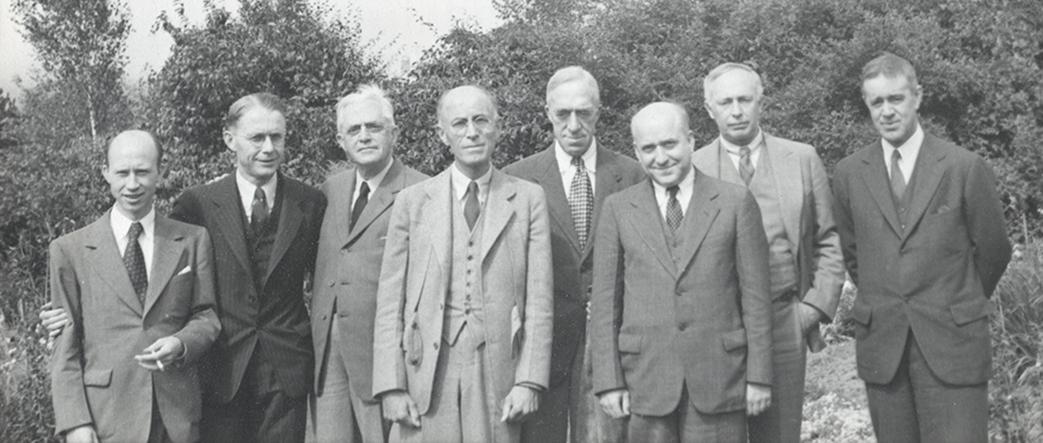
Director Lewis (third from left) with ALI Advisers (date unknown)
1931
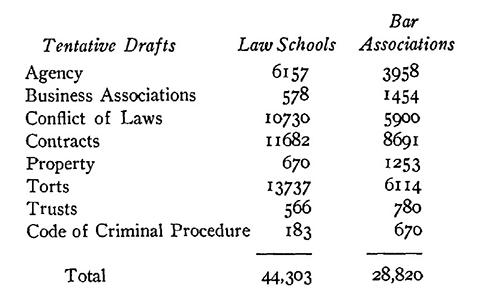
Tentative Draft Sales Reported
Although the Institute had yet to publish a Restatement, the volume of sales of Tentative Drafts and of the Code of Criminal Procedure reflected that the Institute’s work, even in its early stages, was regarded with respect by the legal community.
The preparation of an adequate Restatement of any Subject is a long and arduous task. There is no short cut.
It was understood at this stage that drafts were tentative and not final. Nevertheless, lawyers were purchasing these drafts and using them in preparing briefs. Judges, particularly those in the higher courts, were also citing the Tentative Drafts. In addition to judicial and practical use of the drafts, the use of the Tentative Drafts by law school teachers continued to grow.
The number of drafts of each subject sold as of 1931 to members of the bar and to law schools is listed in the chart below from the ALI’s 1931 Annual Meeting Proceedings.
1932
ALI’s First Restatement Is Published
In the video below, Liability Insurance project Reporter Tom Baker explains the various parts of a Restatement. Black letter, Comments, and Illustrations can all be seen even in the earliest draft of Contracts. Reporter’s (or Reporters’) Notes were included in the Appendix Volumes within the Restatement Second series.
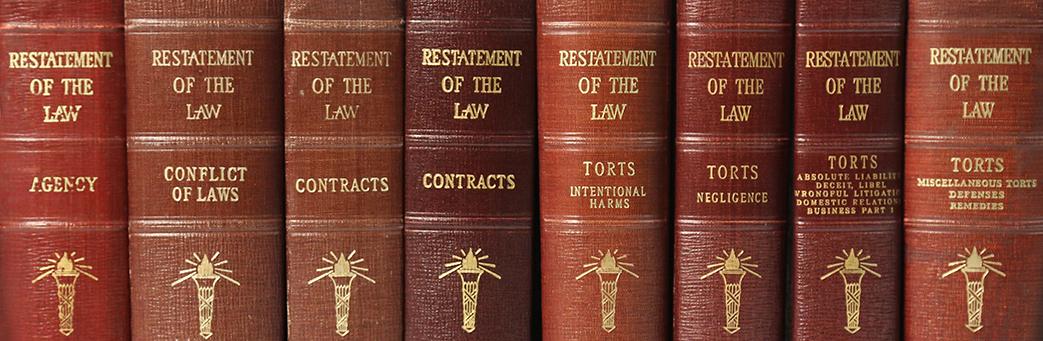
In 1923, work began on the first four Restatements, covering the subjects of Agency, Conflict of Laws, Contracts, and Torts.
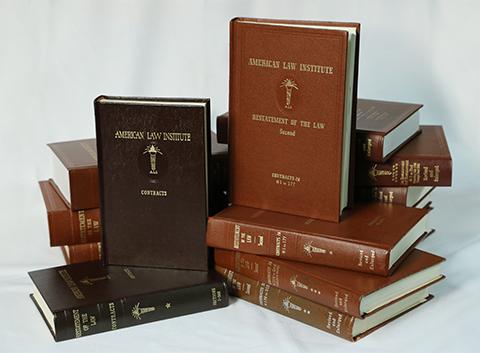
The first official text of these projects to be published was the Restatement of Contracts. Following the first draft that included one Chapter of Definitions and a second on Formation of Simple Contracts, the project produced 50 additional Preliminary Drafts and 17 Final Drafts, was discussed at eight Annual Meetings, and was approved at ALI’s 10th Annual Meeting.
Although not officially published until 1932, the great majority of the Restatement’s drafts were already being used by the courts, by practitioners, and in law schools for more than three years prior to beginning the work of the final revision.
In response to the demand for this Restatement, in September 1928, a revision of the first 177 Sections of the Restatement of Contracts was published as a Preliminary Official Draft. The Tentative Drafts, as well as the Preliminary Official Draft, were considered at conferences of the representatives of State Bar Association Cooperating Committees across the country.
1939
Torts Published
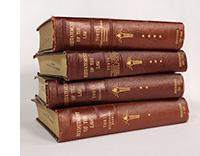
ALI began its work on Torts in June 1923. In 1939, the Institute published the fourth volume of Restatement of the Law, Torts, marking the completion of this 16-year endeavor.
During the project’s life cycle, the editorial organization created to deal with the subject increased from one to five groups. In the year leading up to the final Annual Meeting vote, the five groups working on Torts held 16 conferences on 58 conference days. In all, 145 Preliminary Drafts were considered. Twenty-seven Tentative and Proposed Final Drafts were reviewed and considered by the Council and membership.
1945
Annual Meeting Cancelled
In 1945, due to World War II, the Institute’s Executive Committee decided to not hold an Annual Meeting.
In his Annual Report, Director Lewis explains this decision: “It is not that there are no matters of importance which could be taken up at such a meeting; but our war conditions and the statement of James F. Byrnes rightly prohibits any large meeting not directly connected with the war effort.” The war not only affected ALI's meetings but its publication schedule as well. The publication of Volumes 4 and 5 of the Restatement of Property was delayed due to paper shortage across the country.
1945
ALI and ‘Humanity’s Magna Carta’
One of the lesser-known, but important and influential, projects undertaken by The American Law Institute is the Statement of Essential Human Rights. In the spring of 1941, William Draper Lewis, Director of the Institute, and Warren A. Seavey, Reporter for the Restatements of Agency, Judgments, Restitution, and Torts, began a correspondence that would span four years.
In these letters, they discussed their shared hope for an end to World War II and the “destruction of Hitlerism.” They also discussed the issue of Germany’s future, as well as the broader question of what role the United States should take in the postwar world. In a memorandum issued in 1941, an initial project plan was proposed.
Their discussions led Lewis and Seavey to a shared belief that a just and permanent peace required the recognition of basic human rights, and that the Institute should draft a Statement of Essential Human Rights. Funded by the Carnegie Endowment for International Peace and the American Philosophical Society of Philadelphia, a drafting committee was formed, with representatives from Britain, Canada, China, France, pre-Nazi Germany, India, Italy, Latin America, Poland, Soviet Russia, Spain, and Syria. Its goal was to define the indispensable human rights in terms that would be acceptable to all nations.
Committee members researched the constitutions of other countries and other primary documents relating to individual rights. Throughout the drafting process, Lewis and Seavey disagreed passionately about which human rights should be classified as fundamental. Ultimately they were unable to come to an agreement on the topic.
The Statement was never presented to the ALI membership for a vote, as the ALI Council did not feel that it was advisable for the Institute to draft an international bill of rights. The Council did direct that copies of the committee’s report be distributed to ALI members in 1944.
In 1946, John P. Humphrey was appointed as the first Director of the Human Rights Division in the United Nations Secretariat, and one of his first undertakings was to draft the Universal Declaration of Human Rights. In his 1984 memoir Human Rights and the United Nations: A Great Adventure, he says that “the best of the texts from which I worked was the one prepared by the American Law Institute, and I borrowed freely from it.”
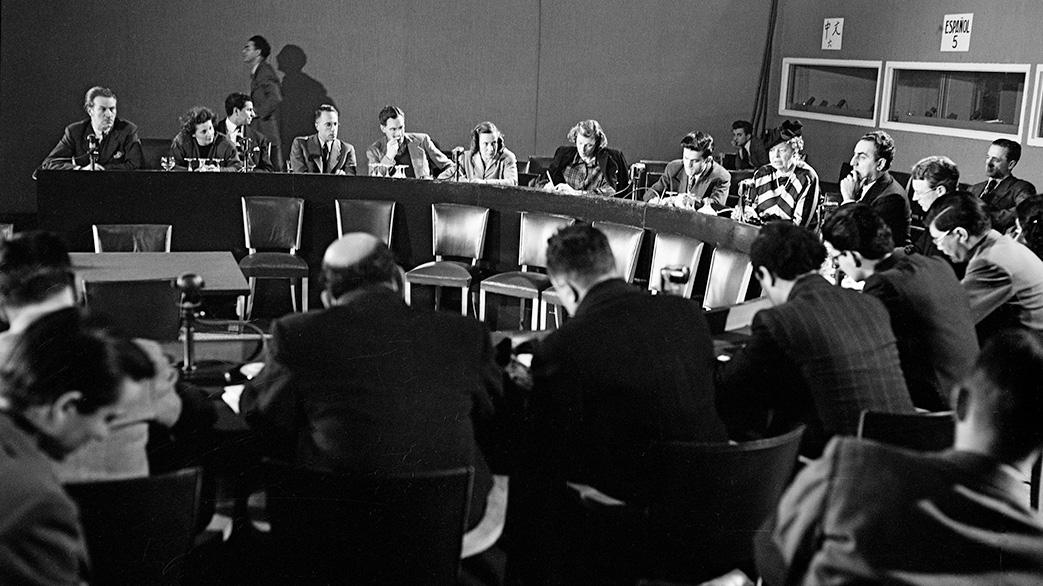
Press Conference on Declaration of Human Rights. Eleanor Roosevelt, Chairman of Human Rights Commission, and Dr. Charles Malik, Chairman of the General Assembly’s Third Committee (second from right), during press conference after the completion of the Declaration of Human Rights. December 7, 1948, Paris, France (Credit: UN Photo).
After its adoption in 1948, the UN’s Universal Declaration of Human Rights went on to become the best-known and most-cited human-rights document in the world. It has been translated into over 500 languages and has been incorporated into the constitutions of many countries to lay a foundation for human rights.
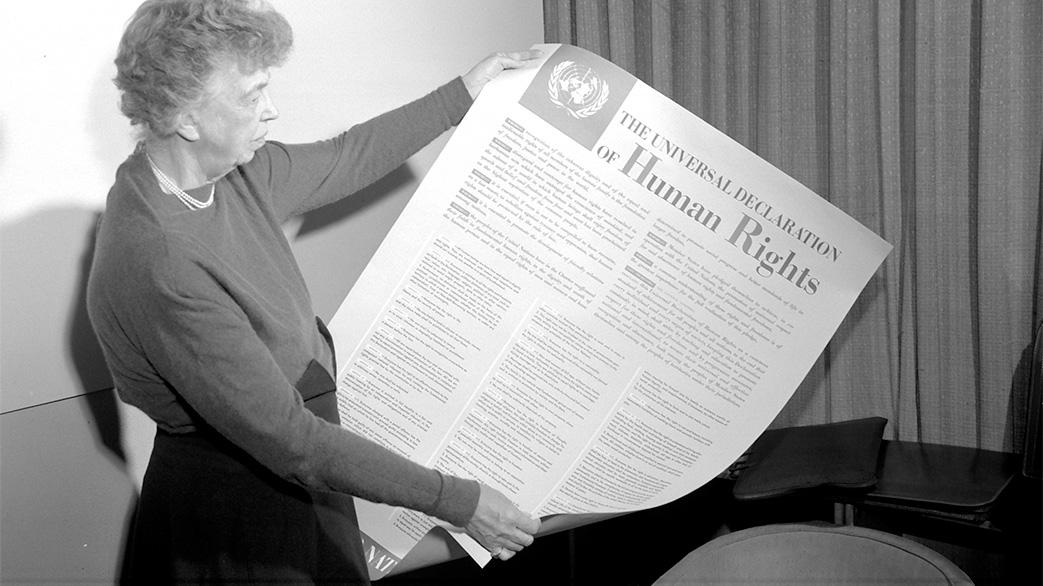
Eleanor Roosevelt holding a Universal Declaration of Human Rights poster in English. [Exact date unknown], United Nations (Lake Success), New York
In her 2003 Annual Dinner speech to the ALI membership, Mary Robinson, former President of Ireland and United Nations High Commissioner for Human Rights, thanked the Institute for its “pioneering and prophetic work” on the Statement of Essential Human Rights.
“The Statement broke new ground in identifying not only civil and political liberties, but also education, food, housing, and social security as human rights, and through its broad membership—from China, the Arab world, India, and Latin America—it anticipated and answered later critics who would claim that human rights are a product of western culture and history. That Statement is something I will come back to, because we need that approach now more than ever, at the start of this new century.”
The history of the Statement of Essential Human Rights demonstrates that the Institute can be influential in the ideas it disseminates, even if it does not always take an official position with the requisite concurrence of both the Council and the members.
Learn more about ALI’s story of assembling the Statement from former ALI President Michael Traynor.
1947
ALI-ABA Is Born
In the aftermath of another world war, at a time when lawyers were returning to work, they found themselves confronted with not only the difficulties of assimilating back into civilian life, but the added challenge of needing to make up for the gaps in their legal knowledge–a result of advancements that had been made during their absence. In light of these deficiencies, and the growing demand for a more structured way to ensure needs were met, the continuing education of the bar became a matter of first importance to the legal profession.
In 1947, the American Bar Association asked ALI to undertake a national program of continuing education of the bar. The Institute immediately saw the importance of this request and agreed to the task. As a result, the effort that the ABA initiated and ALI undertook became ALI-ABA — The American Law Institute-American Bar Association Committee on Continuing Professional Education.
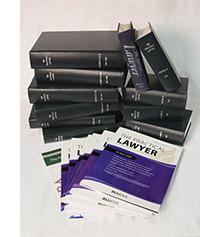
ALI-ABA would assist in the creation of state and local sponsoring agencies (with the help of bar associations, law schools, and other lawyer groups), supply literature and “know how” for lectures, and provide program panelists.
In its first year of operation, following the policy of working with local agencies of the bar, ALI-ABA organized Continuing Legal Education (CLE) lectures in 30 states.
From 1947 to 1968, ALI-ABA produced 654 courses attended by 70,159 lawyers; published 83 titles by 121 authors, some in multi-editions; and sold 499,277 books. The first edition of The Practical Lawyer (still published today) was available in 1955. For 65 years, ALI-ABA would continue to provide thousands of legal seminars and publications to lawyers across the country. In 2012, ALl and the ABA amicably ended their 65-year collaboration in continuing legal education known as ALI-ABA, with each entity moving forward on its own to produce CLE.
1952
Work on Restatement Second Begins
In the Institute’s 1952 Annual Report, Director Goodrich spoke on the importance of continuing work on Restatements.
“Into the Restatement project went a great deal of money. Into this work also went days, months and years of labor by a great many people. That labor will never be lost. But the life of law books is such in this day and age that unless a book, no matter how authoritative, is constantly looked over for necessary revision, it soon becomes obsolete. By obsolete it is not meant that what was said is necessarily no longer the law.
Some legal principles change very slowly. But without fresh assurance of continuous examination, the user can never depend upon the current authenticity of a statement. Even more he is in danger of losing out on some new development or ramification of an old principle. These developments are important in many instances. The Restatement, if it is to speak contemporaneously, must include them. So, five years after our previous re-examination we shall go to work again.”
The Restatement Second includes the following subjects: Agency, Conflict of Laws, Contracts, Foreign Relations Law of the United States, Judgments, Property (Landlord and Tenant), Torts, and Trusts.
The first subjects completed in the Restatement Second were Agency and Trusts. Both were approved at the 1957 Annual Meeting. Agency Second was published in 1958. Trusts Second was published in 1959.
The Editorial Board for the Restatement Second—R. Ammi Cutter, Edwin D. Dickinson, Learned Hand, and ALI’s President and Director—had the responsibility of making decisions on matters of form and style to present the work in the best way possible.
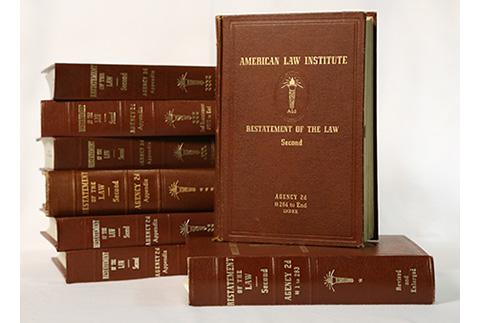
As the first publication in the Restatement Second series, Agency Second was the Institute’s first effort to make an enlarged version and set the standard for the second edition Restatements to follow. “We are changing the size of the pages, quality of paper, the appearance of the binding. In other words, the Second Agency will be a new book.” – 1958 Annual Report from Director Goodrich
Another modification introduced in the Restatement Second series was the development of Reporter’s Notes. Unlike the black letter, and Comments (including Illustrations), the Reporter’s (or Reporters’) Notes are regarded as the work of the Reporter (or Reporters). Reporter’s Notes are not approved by ALI members. Nevertheless, they are submitted for review together with the other components of the Section to which they pertain. Reporter’s Notes set forth and discuss the legal and other sources relied upon by the Reporter(s) in formulating the black letter and Comment and enable the reader better to evaluate these formulations; they also provide avenues for additional research. In addition, the Notes furnish a vehicle for the Reporter(s) to convey views not necessarily those of the Institute and to suggest related areas for investigation that may be too peripheral for treatment in the black letter or Comments. Reporter’s Notes contain lucid analyses of hard problems and the wealth of citations will lead the researchers to case material otherwise hard to find.
The Restatement Second also included court citations to the Restatement First, categorized by date.
1952
The Uniform Commercial Code (UCC)
The Uniform Commercial Code (UCC) is a comprehensive set of laws governing commercial transactions in the United States. It is a uniform code addressed to legislatures with a view toward legislative enactment and written in prescriptive statutory language. The UCC is a modernization of various statutes relating to commercial transactions including sales, leases, negotiable instruments, bank deposits and collections, funds transfers, letters of credit, bulk sales, documents of title, investment securities, and secured transactions.
Learn how the UCC has promoted safe, predictable, reliable commerce for businesses and consumers throughout the United States in the video below.
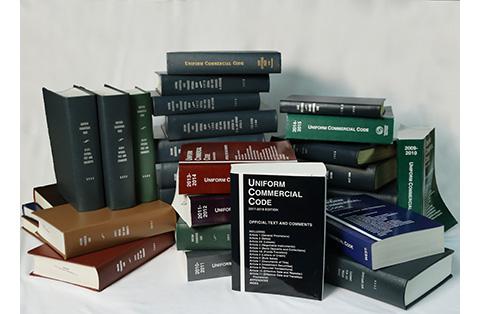
The UCC is a joint project of the Uniform Law Commission (ULC) and The American Law Institute. In 1942, ALI accepted an invitation from the ULC to undertake this massive project. ALI named Karl Llewellyn Chief Reporter and Soia Mentschikoff Assistant Reporter. For the next 10 years, the two organizations worked together to produce the first volume. Published in 1952, the UCC was ALI’s first publication post-WWII.
Because the UCC has been universally adopted, businesses can enter into contracts with confidence that the terms will be enforced in the same way by the courts of every American jurisdiction. The resulting certainty of business relationships allows businesses to grow and the American economy to thrive. For this reason, the UCC has been called “the backbone of American commerce.”
Updates to the UCC were presented to the membership for vote at ALI's 2018 Annual Meeting.
Updated regularly, the UCC is maintained by the Permanent Editorial Board for the Uniform Commercial Code (PEB). The PEB, a joint committee of ALI and the Uniform Law Commission, discourages nonuniform amendments or additions to the UCC by the states, assists in attaining and maintaining uniformity in state statutes governing commercial transactions, and monitors the law of commercial transactions for needed modernization or other improvement.
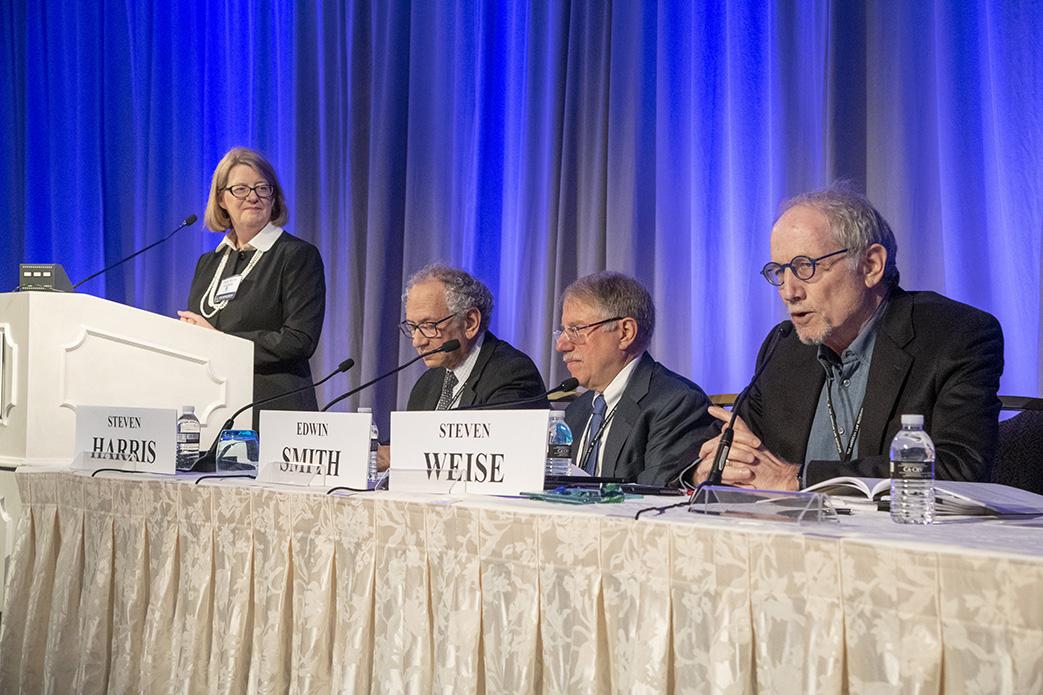
Updates to the UCC were presented to the membership for vote at ALI’s 2018 Annual Meeting.
1962
The Model Penal Code
Although not completed until 1962, the Model Penal Code was the product of a decade of intensive labor by the Institute. Led by Herbert Wechsler, the Model Penal Code project set out to draft a model criminal code that could be adopted by the states. After its publication, 37 states adopted parts of the Code, and several, including New York and New Jersey, adopted nearly all its provisions.
In the video below, Erin E. Murphy, Associate Reporter of the Model Penal Code: Sexual Assault and Related Offenses, and project Adviser Samuel W. Buell discuss the impact and influence of the Model Penal Code.
Shortly after its publicaton, Herbert L. Packer of Stanford hailed the Code in the pages of the Columbia Law Review as “a superb achievement” that “as a contribution to legal scholarship in our time ... has few if any equals.” The Code’s impact, however, has not been confined to the world of scholarship. The Model Penal Code provided the major impetus for the widespread and long overdue reexamination and codification of the substantive criminal law. As Sanford H. Kadish observed in 1978, “the Model Penal Code has by now permeated and transformed the substantive criminal law of the country.”
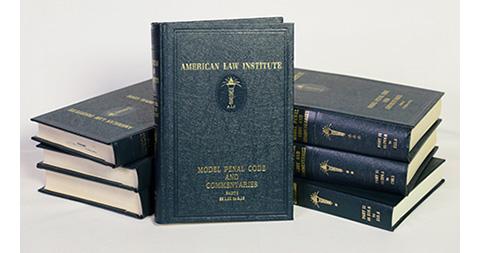
One of the Model Penal Code’s most important contribution to criminal law is its clarification of the different mode of culpability.
The Institute’s 1951 proposal to the Rockefeller Foundation seeking the Foundation’s financial support for the then-unwritten Model Penal Code contained the following statement: “If we are successful, what we do here will affect the thinking about criminal law for the next 50 years, at least, and should be the basis for continued, important, fruitful work.”
To this day, courts continually rely on the Code when a state’s criminal code does not provide guidance.
1965
Foreign Relations Second Published
In the video below, Foreign Relations Fourth Reporters Paul B. Stephan and William S. Dodge discuss the history of the Restatement Second of Foreign Relations Law and its role in formalizing this area of law.
The Restatement Second on the Foreign Relations Law of the United States was an incredibly important piece of work by ALI.
“Foreign Relations Law” as a concept refers to the domestic law of any nation that governs how that nation interacts with the rest of the world—this includes with the nations, themselves, as well as their citizens and institutions. Although this concept was apparent before the launch of the project, the Restatement is often credited with formalizing foreign relations law as a legal field.
The Restatement was made possible by a grant from the Ford Foundation awarded in 1955, after a preliminary study financed by the Rockefeller Foundation. The final approval by the membership occurred in 1962, in the heart of the Cold War, when international relationships were most complex, as exemplified by the Cuban Missile Crisis, which occurred during that year.
In the Introduction to the Restatement, ALI Director Herbert Wechsler wrote:
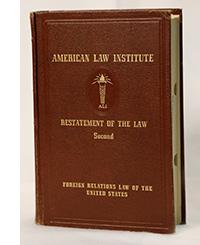
At a time when the maintenance and development of law in the governance of international relationships increasingly engages the attention and the hopes of all mankind, The American Law Institute takes pride in publishing the Official Draft of the Restatement of the Foreign Relations Law of the United States. …
In developing the form of the Restatement the Reporters have taken full account of the important fact that the foreign relations law of the United States derives from legislative and executive action, including international agreements, as well as from judicial decision and that it attributes importance not only to United States precedents but also to decisions of other national tribunals and to the decisions of international tribunals.
1967
Trial Manual Published
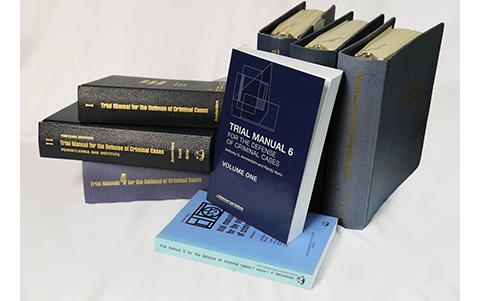
In 1967, A Trial Manual for the Defense of Criminal Cases was published by the ALI-ABA Joint Committee on Continuing Legal Education. The product of the combined effort of the ALI-ABA Joint Committee, the American College of Trial Lawyers, and the National Legal Aid and Defender Association, the Manual was designed for use in a course of study to be conducted throughout the country and as a working document for lawyers involved in the defense of persons accused of crime.
Originally authored by Anthony G. Amsterdam, Bernard L. Segal, and Martin K. Miller, the Manual is designed to be a how-to-do-it exposition for the general practitioner of the law and practice of criminal defense.
1971
The Boskey Motion
Named for longtime ALI Treasurer Bennett Boskey, this motion is made to approve a draft, or portions of a draft, by ALI’s Council (at a Council Meeting) or membership (at an Annual Meeting). A standard structure of the Boskey motion is: “I move we approve [draft] subject to today’s discussion and the usual editorial prerogatives.”
In other words, the members are asked to approve the draft, subject to any requested changes to which the Reporters agreed or any motions that passed during the course of the Meeting, as well as general, nonsubstantive edits that may be required before publishing.
In the video below, Richard L. Revesz (ALI Director 2014-2023), Diane P. Wood (ALI Director 2023- ), and Conrad Harper reflect on the importance of the Boskey Motion to the progress of ALI projects.
1978
First Principles Project Launched
ALI’s first Principles project launched on May 16, 1978, after the Council voted to proceed with a project on the Structure and Governance of Corporations, with former SEC Commission Chairman Ray Garrett Jr. serving as the Chief Reporter.
1978
Work on Restatement Third Begins
The continued reassessment of the law and the Restatements is at the core of the Institute’s function. In support of this goal, the third series of Restatements began in 1978, starting with the topic of Foreign Relations and later adding the topics of Agency, the Law Governing Lawyers, Property, Restitution and Unjust Enrichment, Suretyship and Guaranty, Torts, Trusts, and Unfair Competition.
In 1977, Foreign Relations Reporter Adrian S. Fisher explained how quickly a new edition could be required. “Although the [Foreign Relations] Restatement was published and distributed only twelve years ago, the pace of change in international law has been so rapid that the Council of the Institute recently called for an exploration of the need for reexamination and revision of the work and for its expansion into other fields.”
1979
Torts Second and Strict Liability
In 1979, the Institute finished its reexamination of the subject of torts with the completion of Restatement of the Law Second, Torts. Led by Reporter William Lloyd Prosser, this Restatement included § 402A on the topic of strict liability, approved at the 1964 Annual Meeting, which provides that “One who sells any product in a defective condition unreasonably dangerous to the user or consumer or to his property is subject to liability for physical harm” even if the seller has “exercised all possible care.”
In the video below, Kenneth W. Simons, who serves as Reporter on Restatement of the Law Third, Torts: Intentional Torts to Persons, discusses § 402A and strict liability.
1985
Membership Extended to Foreign Lawyers
In May 1985, the Institute’s Council amended its rules to allow entry to membership for foreign lawyers. This profound change allowed the Institute to make progress towards its goal of making a difference in the global law community. The first members to be chosen in the new category were a group of distinguished representatives of the British legal profession, which included Baron Scarman (Leslie George Scarman), former Chairman of the British Law Commission and Lord Justice of Appeal.
In July of 1985, the Institute held a special ceremony in conjunction with the London meeting of the American Bar Association to induct these new foreign members. It was ALI’s first event across the pond.
1986
Introduction of Members Consultative Groups
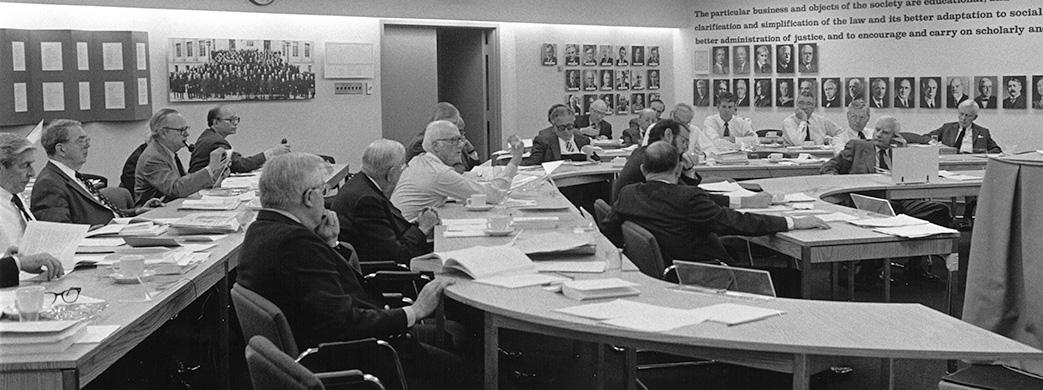
In 1986, the Institute’s newly formed Committee on Member Participation approved an experimental program calling for the creation of a Members Consultative Group (MCG) for some of its new projects. An MCG is made up of ALI members who volunteer to join project discussions at any stage of a project’s life cycle. MCG members are not necessarily experts in the project’s area of law, but provide a vital perspective, as they read the drafts from a generalist’s point of view. MCG participants provide input by attending project meetings and by submitting written comments. The core purpose of the MCG was to more effectively utilize the great resources, knowledge, and expertise of the Institute’s members.
For many years the Institute seemed to function well with the principal involvement of most members consisting of the review of Tentative Drafts and attendance and voting at the Annual Meeting. However, in the 1980s, then ALI President Roswell Perkins sensed frustration among many members because they wanted to play a more useful role in the functioning of the Institute. Similarly, new members often asked how they might become active and contribute to the evolution of the drafts, rather than reviewing a work product that was essentially in final form.
The topic of The Law Governing Lawyers was the first project to have an MCG. At the conclusion of the project, Chief Reporter Charles W. Wolfram of Cornell Law School noted, “Without in the least devaluing the enormous contribution of our Advisers, I would have to say that we often pick up insights and critiques from the Group that we have not received from the Advisers … I would say that the impact of Members through the Group has been truly significant.”
1988
The Henry J. Friendly Medal Established
Established in memory of Henry J. Friendly and endowed by his former law clerks, the Henry J. Friendly Medal recognizes contributions to the law in the tradition of Judge Friendly and the Institute.
The medal is not presented on an annual basis, but rather is reserved for recipients who are considered especially worthy of receiving it.
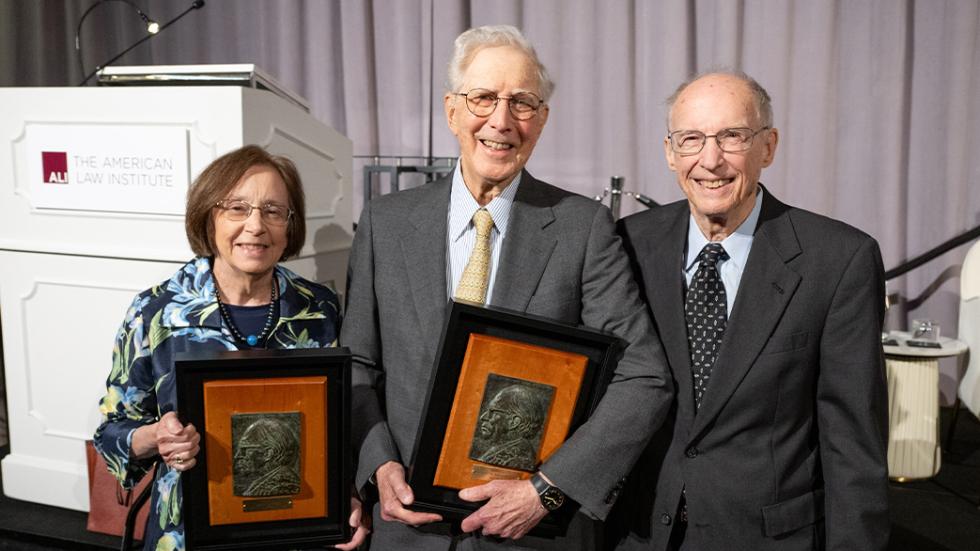
Judge Pierre N. Leval presents the Friendly Medal to Judge J. Harvie Wilkinson III and ALI Director Diane P. Wood
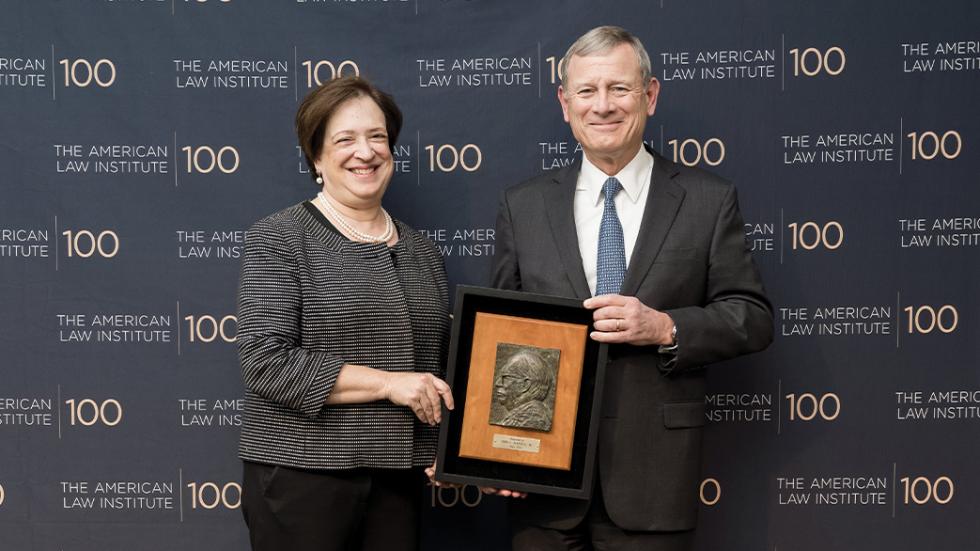
Associate Justice Elena Kagan presents the Friendly Medal to Chief Justice of the United States John G. Roberts, Jr.
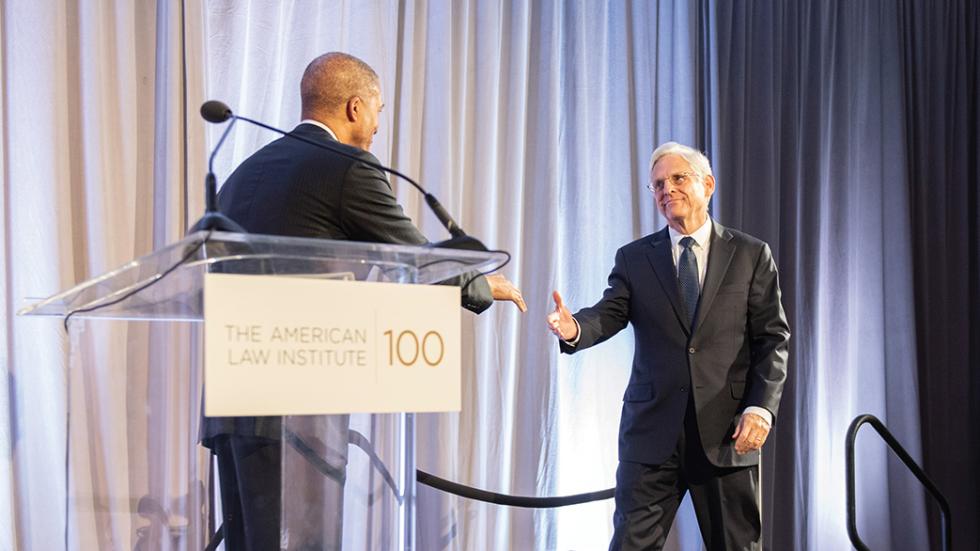
Judge Raymond J. Lohier Jr. presents the Friendly Medal to U.S. Attorney General Merrick B. Garland
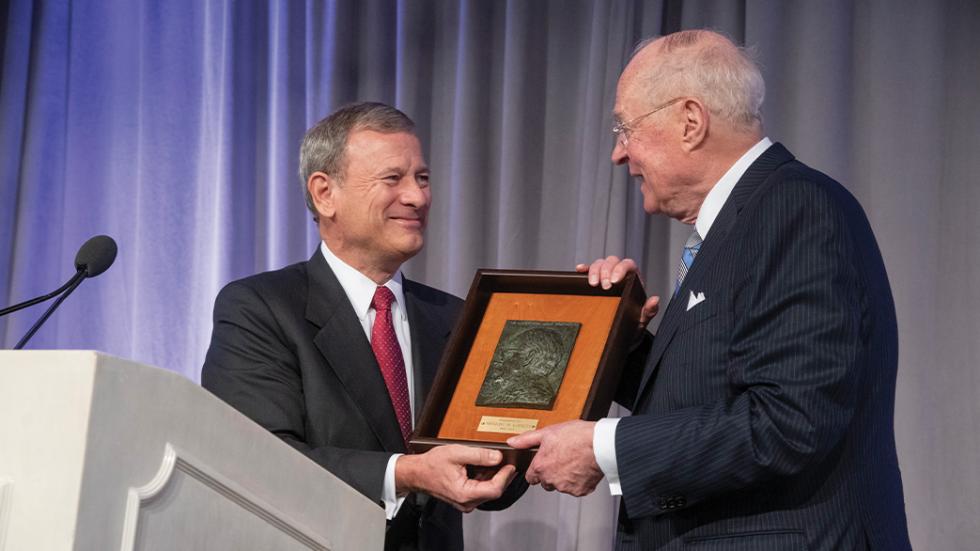
Chief Justice of the United States John G. Roberts, Jr. presents the Friendly Medal to Retired U.S. Supreme Court Associate Justice Anthony M. Kennedy
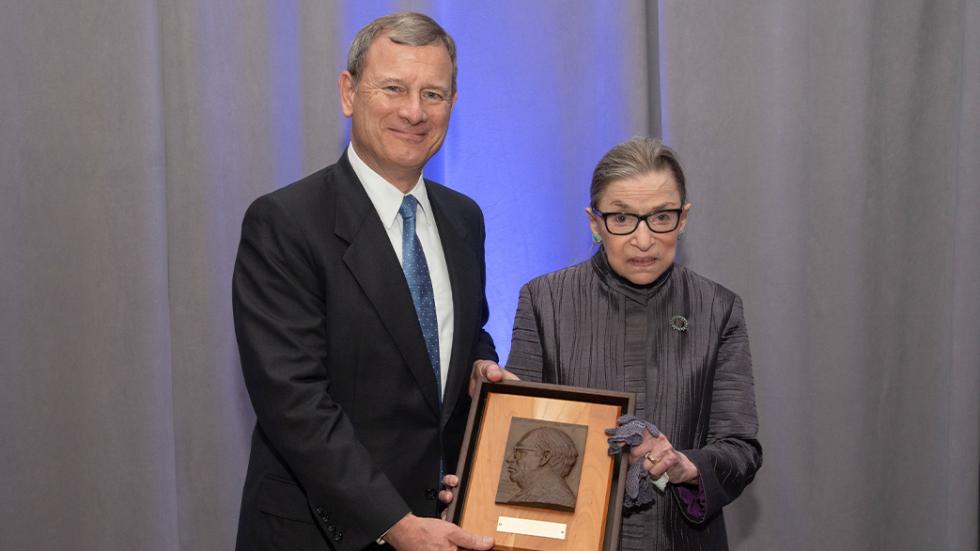
Chief Justice of the United States John G. Roberts, Jr. presents the Friendly Medal to Associate Justice Ruth Bader Ginsburg
Friendly, who died on March 11, 1986, at the age of 82, served on the U.S. Court of Appeals for the Second Circuit from 1959 until his death. He was a member of the ALI Council for a quarter of a century and an Adviser for the Study of the Division of Jurisdiction Between State and Federal Courts; the Model Code of Pre-Arraignment Procedure; the Federal Securities Code; and the Principles of Corporate Governance.
The first Friendly Medal was awarded to Edward Weinfeld of the U.S. District Court for the Southern District of New York. ALI President Roswell Perkins presented the award on January 16, 1988, in a ceremony at Weinfeld’s home. The presentation took place in the presence of his family and a few of his clerks and close friends, just one day before Weinfeld’s death. Upon presenting the award, Perkins reflected on the lives of Friendly and Weinfeld:
We view this as a celebration of the intellectual and spiritual kinship of two individuals that have so much in common. There is a universal admiration in the legal world for the integrity and quality of the scholarship of these two men; a universal appreciation of their dedication to public service and to the improvement of the processes of government; and a universal recognition of the humanity and quality of friendship and love that is in you, Ed, and that Henry displayed in his lifetime.
Friendly was undoubtedly one of the greatest judges of his time, and his spirit and dedication to the rule of law continue to be embodied by the recipients of this prestigious award. To learn more about Friendly, read the remarks delivered by Pierre N. Leval of the U.S. Court of Appeals for the Second Circuit and a former clerk of Friendly, on the presentation of the Friendly Medal to U.S. Supreme Court Justice Sandra Day O'Connor in 2011.
The most recent recipient of the Friendly Medal is Chief Justice of the United States John G. Roberts, Jr. Below is the full list of Friendly Medal recipients:
J. Harvie Wilkinson and Diane P. Wood (2026)
John G. Roberts, Jr. (2023)
Merrick B. Garland (2022)
Anthony M. Kennedy (2019)
Ruth Bader Ginsburg (2018)
Conrad K. Harper (2017)
Patricia M. Wald (2016)
Michael Boudin and Pierre N. Leval (2014)
William H. Webster (2013)
Sandra Day O'Connor (2011)
Nicholas de B. Katzenbach (2009)
Ronald M. Dworkin and Richard A. Posner (2005)
Anthony Lewis and Linda Greenhouse (2002)
William T. Coleman Jr. (2000)
Herbert Wechsler (1993)
Paul A. Freund (1989)
Edward Weinfeld (1988)
1990
John Minor Wisdom Award Established
The Wisdom Award was established in honor of Council member John Minor Wisdom, former judge on the U.S. Court of Appeals for the Fifth Circuit. The award was endowed in 1990 by Wisdom’s then-present and former law clerks, who did so on the occasion of the celebration of his 85th birthday.
Wisdom served on the U.S. Court of Appeals for the Fifth Circuit during the 1950s and 1960s when the court became known for a series of decisions crucial in advancing the civil rights of African Americans. Until 1981, the Fifth Circuit included Alabama, Florida, Georgia, and the Panama Canal Zone in addition to its current states of Louisiana, Mississippi, and Texas.
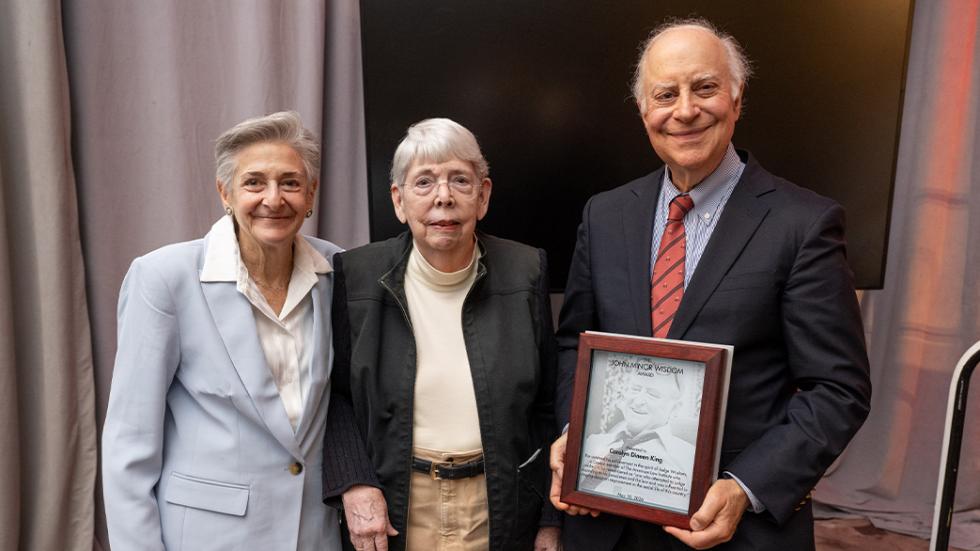
Judge Carolyn Dineen King is presented with the Wisdom Award at the 2026 Annual Meeting by Judge Lee H. Rosenthal.
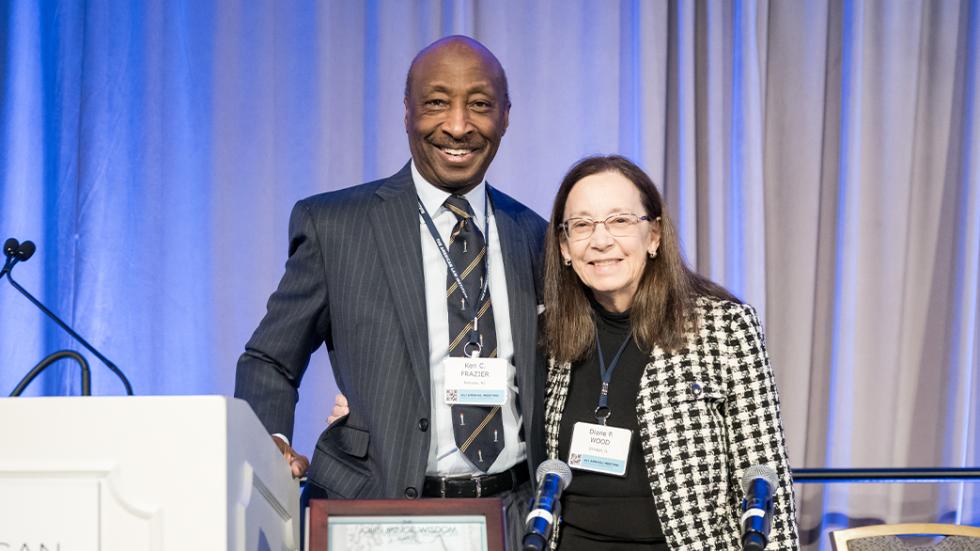
ALI Director Diane P. Wood presents the Wisdom Award to Kenneth C. Frazier
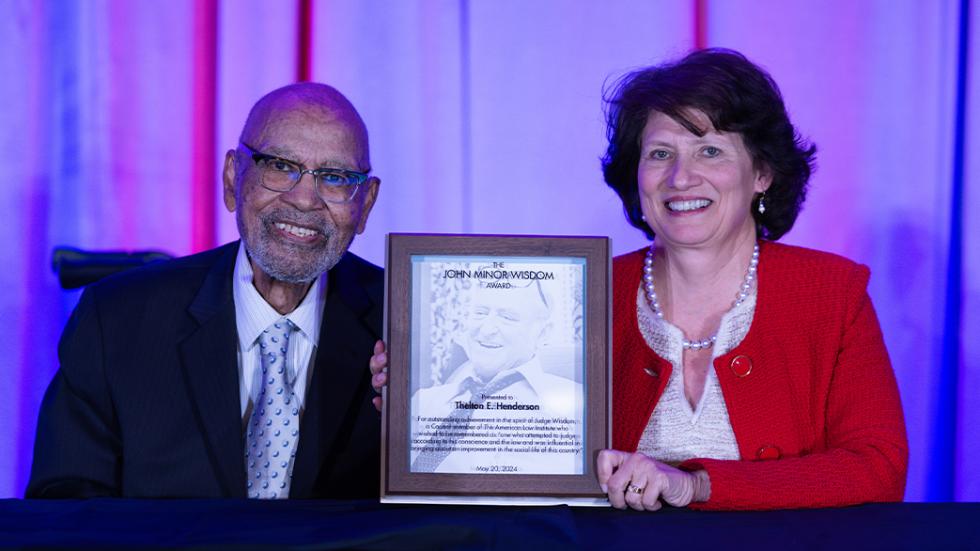
Judge Yvonne Gonzalez Rogers presents the Wisdom Award to Retired Judge Thelton E. Henderson
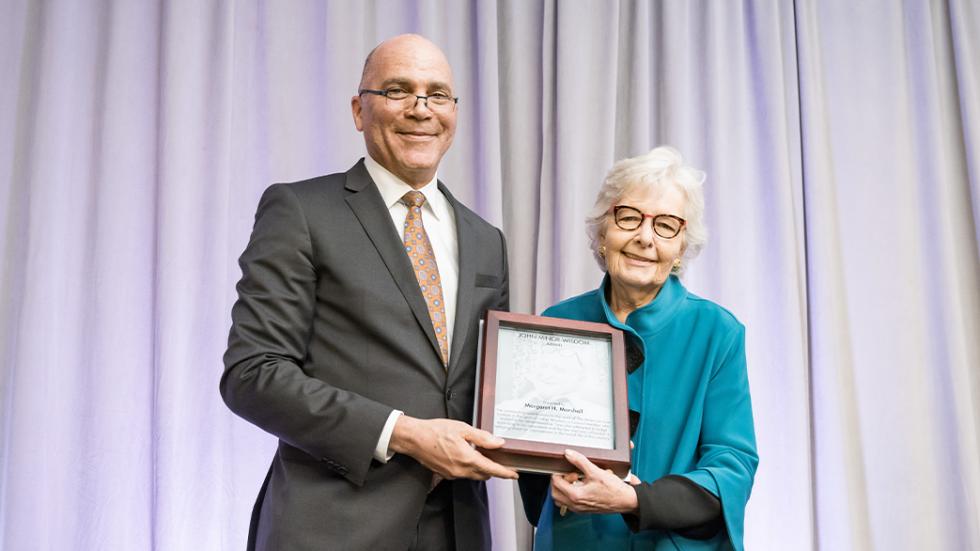
ALI President Wallace B. Jefferson presents the Wisdom Award to Margaret H. Marshall
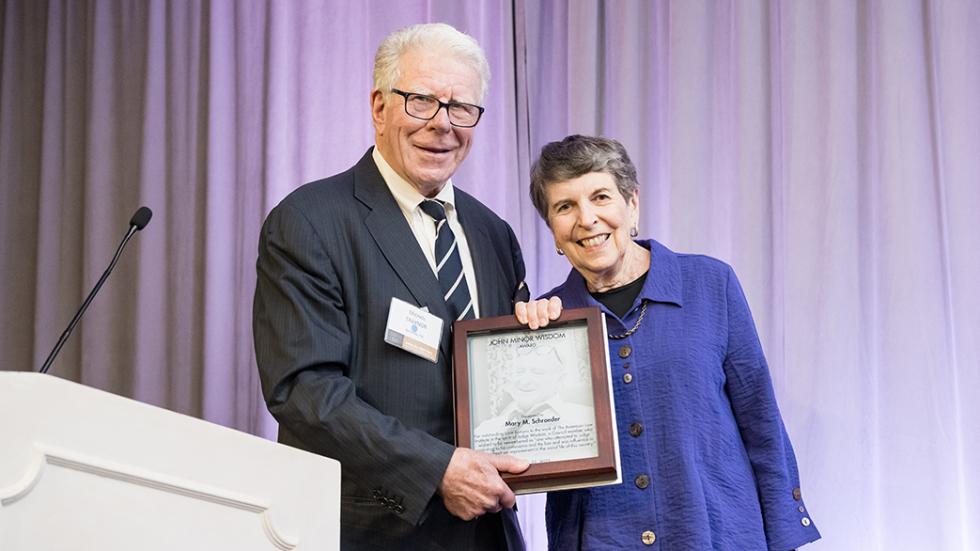
Michael Traynor (ALI President 2000-2008) presents the Wisdom Award to Judge Mary M. Schroeder
Writing for the majority in U.S. v. Jefferson County Board of Education in 1966, he wrote:
“The Constitution is both color blind and color conscious. To avoid conflict with the equal protection clause, a classification that denies a benefit, causes harm, or imposes a burden must not be based on race. In that sense, the Constitution is color blind. But the Constitution is color conscious to prevent discrimination being perpetuated and to undo the effects of past discrimination. The criterion is the relevancy of color to a legitimate governmental purpose.”
The Wisdom Award is not presented annually, but instead is given from time to time in specific recognition of a member of the Institute for outstanding contributions to the work of the Institute. Below is the list of recipients.
Carolyn Dineen King (2026)
Kenneth C. Frazier (2025)
Thelton Henderson (2024)
Margaret H. Marshall and Mary M. Schroeder (2023)
Neil B. Cohen (2014)
Guy Miller Struve (2011)
Jack B. Weinstein (2006)
Michael Marks Cohen (2004)
Donald J. Rapson (1999)
M. Bernard Aidinoff (1995)
W. Loeber Landau (1993)
1991
Cutter Reporter's Chair Established
The first Reporter’s Chair was established in the name of then-Chairman of the Council Emeritus R. Ammi Cutter, retired Justice of the Massachusetts Supreme Judicial Court and former President of the Institute (1976-1980). The Cutter Chair is occupied by an active ALI Reporter of proven effectiveness for the remaining duration of the project on which the Reporter is engaged.
Cutter was an ALI member for more than 55 years. He joined the Council in 1949 and was elected Second Vice President in 1964, First Vice President in 1968, and then President in 1976. He served as an Adviser to the Model Land Development Code; the Model Code of Pre-Arraignment Procedure; the Restatement Second of Property (Landlord and Tenant); the Restatement Second of Property (Donative Transfers); the Restatement Second of the Foreign Relations Law of the United States; and the Restatement Second of Conflict of Laws.
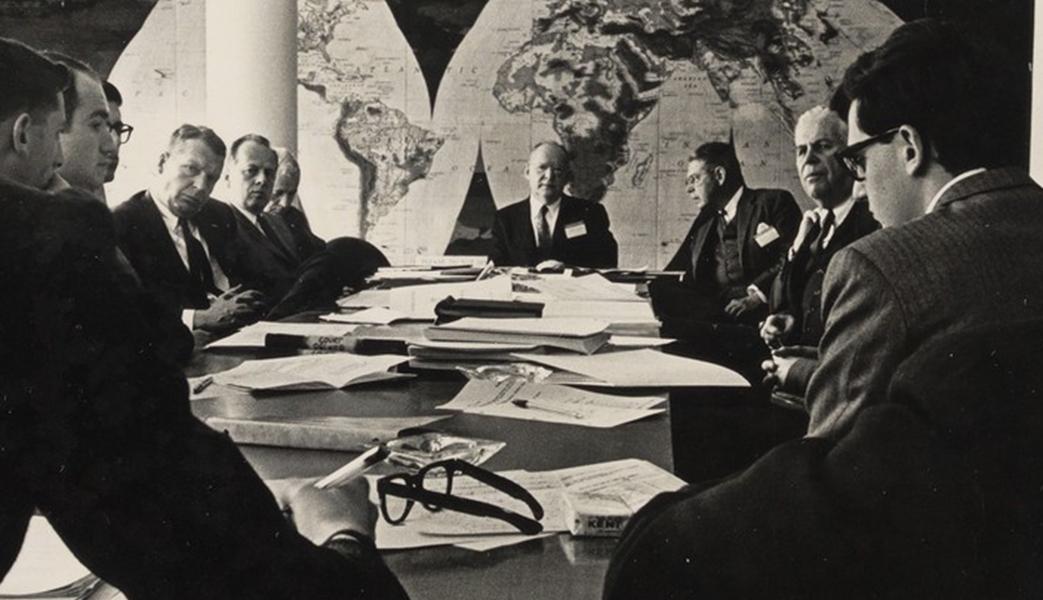
Members of the Harvard Law School Visiting Committee, including R. Ammi Cutter, meeting with students from the Harvard Legal Aid Bureau | Credit: Harvard Law School Library, Historical & Special Collections
The following individuals have held the Chair since it was established:
Nora Freeman Engstrom, Restatement of the Law Third, Torts: Miscellaneous Provisions (2022- )
Andrew Kull, Restatement of the Law Third, Restitution and Unjust Enrichment (2006–2011)
William C. Powers Jr. and Michael D. Green, Restatement of the Law Third, Torts: Liability for Physical and Emotional Harm (2001–2006)
Ira Mark Ellman, Katharine T. Bartlett, and Grace Ganz Blumberg, Principles of the Law of Family Dissolution (1998–2001)
James A. Henderson Jr. and Aaron D. Twerski, Restatement of the Law Third, Torts: Products Liability (1997–1998)
Neil B. Cohen, Restatement of the Law Third, Suretyship and Guaranty (1994–1997)
Melvin A. Eisenberg, Principles of Corporate Governance (1991–1994)
1992
Casner Reporter’s Chair Established
In the history of the ALI, there have been many Reporters, Advisers, and members who have contributed to the success of the Institute. The late A. James Casner is near the top of this list as he was a vital Reporter and Adviser to the Institute for more than half a century. Casner’s work had a profound and revolutionary effect on the law of property, the taxation of trusts and estates, and estate planning.
Following Casner’s death, President Perkins addressed the following words to the Council: “As the Reporter with the longest history of service to the Institute in that capacity, he carved a niche in ALI history that is unlikely ever to be duplicated. He earned a special place in the hearts of all who knew him.”
1992
The Prudent Investor Rule
In 1992, The American Law Institute published Restatement of the Law Third, Trusts (Prudent Investor Rule), which revised portions of the Restatement Second of Trusts. Since its approval, every state has adopted a version of the modern Prudent Investor Rule, dramatically transforming the law of trusts and other fiduciary investments. Rooted in the teachings of Modern Portfolio Theory (MPT), the Rule abolishes all categorical restrictions on investments and imposes a portfolio-as-a-whole standard of care that includes an augmented duty to diversify.
In this video, Robert H. Sitkoff of Harvard Law School details the history and evolution of fiduciary law that led to the Prudent Investor Rule, and the Rule’s continuing influence today.
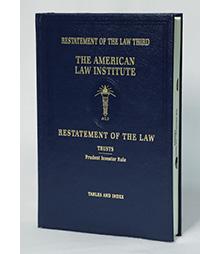
The Prudent Investor Rule has been quoted or cited in numerous bank trust-officer manuals and by government agencies, and has therefore played a significant role in shaping law and policy. In addition to references made in The FDIC Trust Examination Manual and in publications by the IRS, the rule is cited in the Comptroller of the Currency’s Investment Management Services – Comptrollers’ Handbook, which states:
The incorporation of MPT into trust law was significantly advanced by the adoption of the Restatement (Third) of Trusts by the American Law Institute in May 1990. ERISA’s statutory and regulatory standards for prudent investing, diversification, and delegation of pension plan fiduciaries are also reflected in the Restatement (Third). Specifically, section 227 of the Restatement (Third) recognizes an expansion of the fiduciary responsibilities of trustees and provides greater latitude in fulfilling such responsibilities.
The American Law Institute’s restatements of trusts have been influential with lawyers, professional trustees, and the courts over the years as summaries of state laws and judicial decisions governing the conduct of trustees. It has greatly influenced the development of trust law in the United States.
The Prudent Investor Rule continues to be highly influential.
1994
First Principles Project Completed
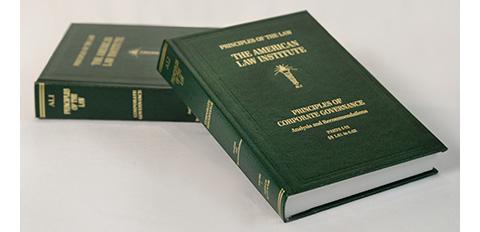
When completed in 1994, the Corporate Governance project was almost as old as the Institute itself. At a meeting of ALI’s founding committee on February 23, 1923, ALI’s founders shared their report that included a section entitled “The Topics Which the Institute May First Undertake to Restate.” One of the first topics suggested was business corporations.
The Committee Reporters observed:
“The major part of the law of business corporations is the result of decisions made in the past fifty years. The importance of the subject is obvious. The present uncertainty of the law pertaining to it is not so much due to conflicts in decisions and statutes as between state and state, or to an overelaboration of rules for the application of fundamental principles, as it is to a confusion and conflict in regard to the legal character of the association and to real differences of opinion as to the correct statement of the fundamental principles applicable to the solution of the more difficult problems presented.”
2000
Going Global: ALI in London
The principal theme of my presidency of The Institute has been the need for strengthening the international aspects of our work.
In keeping with his goal to reach the global law community, ALI President Charles Alan Wright proposed a reception in London, England, in the summer of 2000 (to coincide with the ABA annual meeting). The timing seemed especially appropriate in light of the increased globalization of both the Institute’s membership and work.
This was, however, not the first time ALI held an event in England. In 1985, the Institute held an event to honor Lord Leslie Scarman, former Chairman of the British Law Commission. The event also celebrated the election to ALI of nine members of the UK bar to the newly created category of nonresident members.
Sadly, Wright died just 10 days before the 2000 event, on July 7, at the age of 72. On July 17, the Institute held its reception at the legendary Army & Navy Club. The circumstances of Wright’s death transformed the event into a tribute and remembrance.
2006
Distinguished Service Award Established
The Distinguished Service Award is given from time to time to a member who over many years has played a major role in the Institute, accepting significant burdens as an officer, Council member, committee chair, or project participant and helping keep the Institute on a steady course.
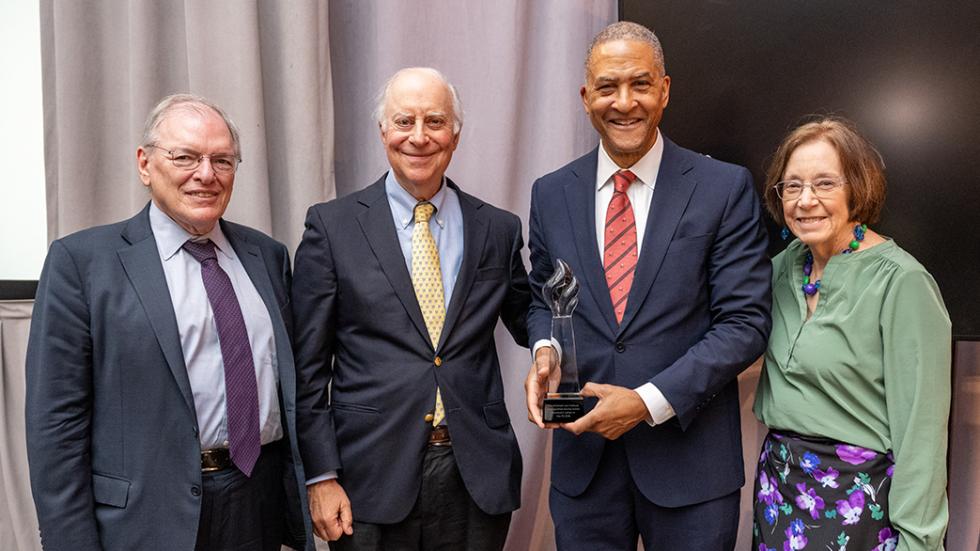
Judge Raymond J. Lohier Jr. is presented with the Distinguished Service Award at the 2026 Annual Meeting by Judge Gerard E. Lynch.
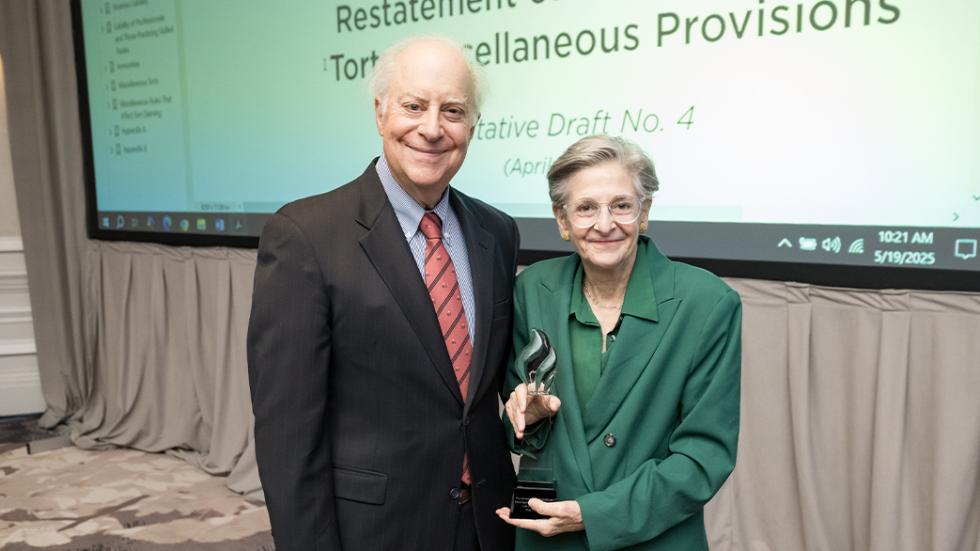
David F. Levi (ALI President 2017-2026) presents the Distinguished Service Award to Judge Lee H. Rosenthal

Roberta Cooper Ramo (ALI President 2008-2017) presents the Distinguished Service Award to Lance Liebman (ALI Director 1999-2014)

ALI Director Diane P. Wood presents the Distinguished Service Award to Roberta Cooper Ramo (ALI President 2008-2017)
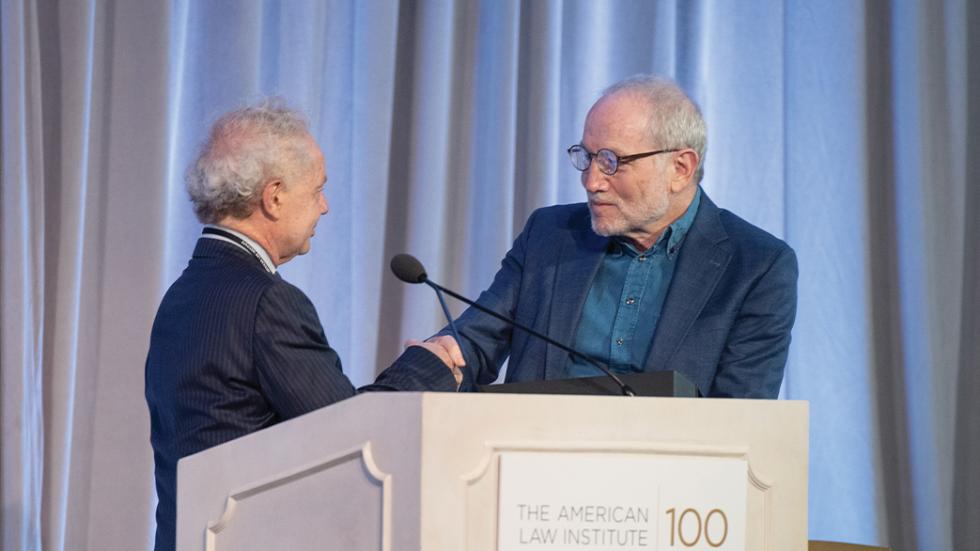
Richard L. Revesz (ALI Director 2014-2023) presents the Distinguished Service Award to Steven O. Weise
2009
Death Penalty Withdrawn from Model Penal Code
In 2001, ALI launched a project to revisit the Sentencing provisions of the 1962 Model Penal Code. During the course of that project, a motion was presented at the 2007 Annual Meeting that urged the Institute to take a position against the death penalty. At that time, no vote was taken, but Council took the motion under advisement and formed an Ad Hoc Committee on the Death Penalty (committee members included Christine Durham, Kay Knapp, Gerard Lynch, Myles Lynk, Daniel Meltzer (Chair), and William Webster). The ALI Program Committee, chaired by Paul Friedman, reviewed member comments and the report by the Ad Hoc Committee and recommended further study—to be completed by Carol and Jordan Steiker.
The study produced by the Steikers examined whether or not the death penalty was in fact being administered in compliance with the U.S. Constitution. They found that there are too many obstacles, both structural and institutional, to administering the death penalty in a non-arbitrary way, and recommended that ALI avoid any attempt to come up with new rules regarding its proper administration.
2011
Early Career Scholars Program Begins
The American Law Institute awards the Early Career Scholars Medal to one or two outstanding early-career law professors whose work is relevant to public policy and has the potential to influence improvements in the law.
The award was created to encourage practical scholarly work and to publicize the work of the honorees by sponsoring conferences on issues related to their work. Honorees are also asked to speak at an Annual Meeting. Formerly known as the Young Scholars Medal, the program is funded by the generous contributions of our members.
2012
Work on Restatement Fourth Begins
In 2012, work began on the Fourth series of Restatements with the launch of Restatement of the Law Fourth, The Foreign Relations Law of the United States: Selected Topics in Treaties, Jurisdiction, and Sovereign Immunity, which became the first publication completed in the Restatement Fourth series in 2018.
2012
ALI Produces Independent Continuing Legal Education Courses
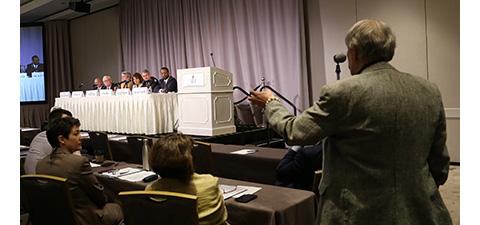
On April 30, 2012, after much discussion, ALl and the ABA amicably ended their 65-year collaboration in continuing legal education known as ALI-ABA, with each entity moving forward on its own to produce continuing legal education programs. The ALI's effort in providing continuing legal education to lawyers became known as ALI CLE.
In 2025, The American Law Institute began hosting CLE courses with a focus on in-person full- and multi-day conferences, including a live broadcast. The Institute is very proud to continue its service to lawyers throughout the United States.
2014
Updates to the Restatement Numbering Protocol
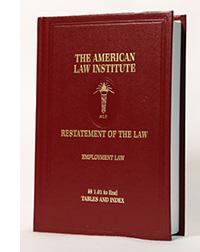
Beginning in 2014, the way that Restatements are “numbered” changed. Previously, Restatements were numbered based on their “series.” For example, the Restatement Second series began in 1952, thus any Restatement that launched from that date is a “Restatement of the Law, Second …” This is true even for Restatements that did not have a previous “edition,” i.e., Restatement Second of Foreign Relations Law.
The Council voted to change this structure in October 2014. From that date forward, Restatements are numbered consecutively. Numbering of previously published Restatements will not be changed.
For example, the Restatement of Employment Law (2015), the first in its series, is titled Restatement of the Law, Employment Law; whereas Restatement Fourth of Foreign Relations Law (2018) followed the Restatement Third of Foreign Relations Law (1987).
2015
ALI as Institutional Author in Citations
Through its 19th edition, The Bluebook provided that Restatements of the Law and Model Codes should be cited by their title, followed by their year of publication. The relevant rule indicated that the name of the author should be indicated parenthetically, unless the work was authored by the American Bar Association; The American Law Institute; the National Conference of Commissioners on Uniform State Laws, also known as the Uniform Law Commission (ULC); or a sentencing commission.
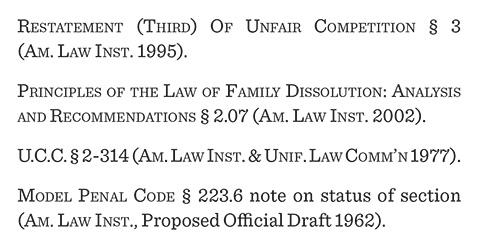
In 2015, ALI worked with the leadership of The Bluebook to be acknowledged as the institutional author of our works. ALI publications are now cited as such:
2018
First Joint Project with European Law Institute
The Principles for a Data Economy project was the first project undertaken jointly by ALI and the European Law Institute (ELI), which, like the ALI, is a membership-based, independent nonprofit organization with the mission of providing guidance on legal developments.
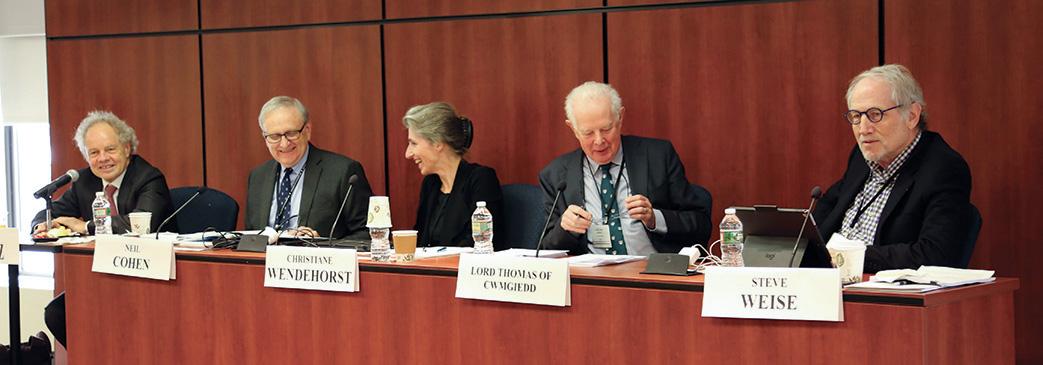
ALI Director Richard L. Revesz, Reporters Neil B. Cohen of Brooklyn Law School and Christiane C. Wendehorst of University of Vienna, with Project Chairs Lord Thomas of Cwmgiedd of Essex Court Chambers and Steven O. Weise of Proskauer Rose
2019
Three Projects Begin to Complete Restatement Third of Torts
In 2019, ALI launched three projects, which will complete the ongoing Restatement Third of Torts. The three projects are Defamation and Privacy, Remedies, and Concluding Provisions.
The revision of the Restatement Second of Torts began in the early 1990s. Portions of the Restatement Second have been superseded by the Restatement Third of Torts: Products Liability, Apportionment of Liability, and Liability for Physical and Emotional Harm and Liability for Economic Harm. Two additional torts categories are being covered in current projects: Intentional Torts to Persons and Property Torts.
Restatement of the Law, Torts was one of the first projects launched in 1923, when ALI was founded. To date, the Torts publications are ALI’s most cited works in court opinions, including the Supreme Court of the United States.
2019
Launch of Corporate Governance Restatement
The Institute first tackled the subject of corporate governance more than 25 years ago in Principles of Corporate Governance: Analysis and Recommendations. Although it provided valuable guidance in a new and unfamiliar area of law at the time, this area has evolved quite a bit in the intervening decades. This project will examine the current state of the law and reflect it in the Restatement.
2019
ALI Documentary
2020
Annual Meeting Cancelled for Second Time
In response to the ongoing coronavirus pandemic, the Institute’s Executive Committee decided to cancel the 2020 Annual Meeting, originally scheduled for May 18-20 in San Francisco, California.
This is only the second time in the Institute’s long history that the Annual Meeting has been cancelled.
Read the message from ALI President David F. Levi on the cancellation of the Meeting.
2021
ALI Holds First Virtual Annual Meeting
In response to group gathering and travel restrictions imposed as a result of the coronavirus pandemic, ALI held its 2021 Annual Meeting on a virtual platform—a first for the Institute. Members, project participants, and guests gathered virtually on May 17-18 and June 7-8.
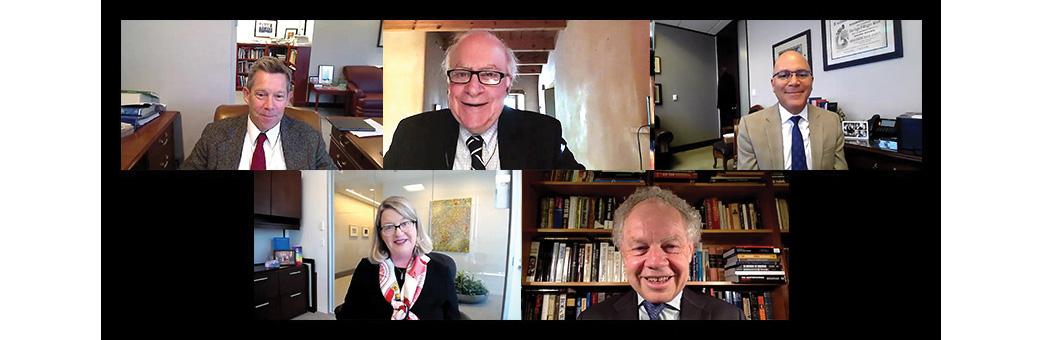
The 2021 virtual Annual Meeting opening session included a business report update from ALI Leadership (clockwise from left to right): Nominating Committee Chair Jeffrey S. Sutton, President David F. Levi, Treasurer Wallace B. Jefferson, 2nd Vice President Teresa Wilton Harmon, and Director Richard L. Revesz.
The agenda included sessions on eleven projects, including four projects that were presented for the first time to membership: Restatement of the Law, Copyright; Restatement of the Law Third, Conflicts of Law; Principles for a Data Economy; and Restatement of the Law Fourth, Property. Of the eleven projects presented to membership, four of the project drafts approved by membership marked the completion of the project, subject to the discussion at the Meeting and the usual editorial prerogative:
Restatement of the Law, The Law of American Indians
Principles of the Law, Compliance and Enforcement for Organizations
Restatement of the Law Third, Torts: Intentional Torts to Persons
Additionally, membership voted to approve Tentative Draft No. 5 of Model Penal Code: Sexual Assault and Related Offenses. Approval of this draft marks the completion of the project, subject to the Council’s approval of the amendments approved at the Annual Meeting.
2022
Reforming the Electoral Count Act
The events of January 2021 generated calls for reform and the development and discussion of various approaches to urgently needed revision of the Electoral Count Act (ECA). Enacted 135 years ago in the years following the disputed 1876 presidential election, the ECA governs Congress’s constitutional role in counting each state’s electoral votes for President and Vice President. The statute has been widely criticized as poorly written, open to conflicting interpretations, and on uncertain constitutional footing.
At the invitation of the leadership of ALI, a group whose members span a range of legal and political views came together to consider possible ECA reforms. Despite holding diverse legal, political, and ideological commitments, the group was united by the belief that Congress should reform the ECA before the 2024 presidential election.
Led by co-chairs Bob Bauer and Jack Goldsmith, the group agreed on several general principles that should guide ECA reform, as well as specific proposals as to what ECA reform should seek to accomplish. Read the group's set of principles here.
2023
Happy 100th Anniversary, ALI
February 23, 2023, marked ALI’s 100th Anniversary. The work accomplished in the last century would not have been possible without the dedication of our members. Thank you to all who have contributed to our work and mission to clarify, modernize, and improve the law.
In May 2023, members gathered at the Annual Meeting to celebrate ALI's Centennial. Since its founding in 1923, the Institute has brought together judges, lawyers, and academics to clarify, modernize, and improve the law. Over the course of a century, ALI has produced Restatements, Principles, Model Codes, and other projects that have influenced courts, legislatures, legal education, and legal practice throughout the United States and beyond.
The centennial celebration honored the generations of members whose contributions made this work possible while reaffirming the Institute’s commitment to its mission for the century ahead.
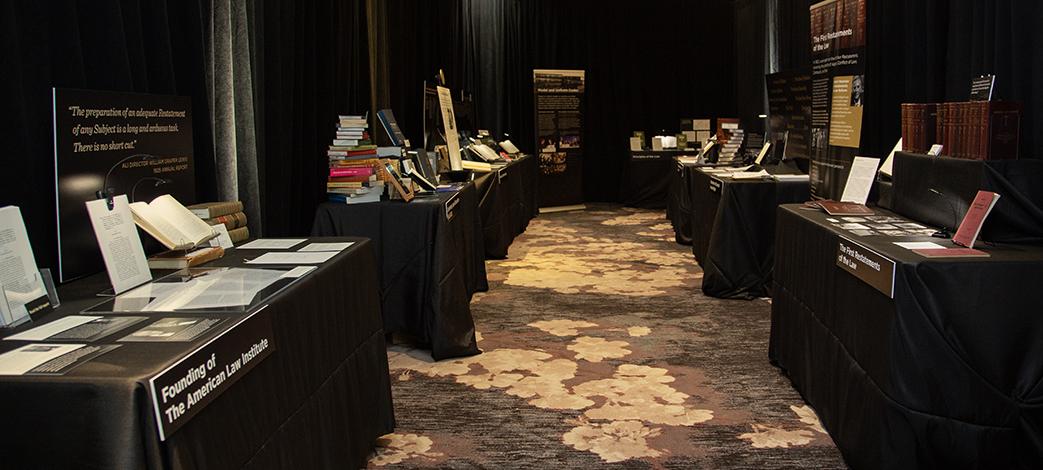
A centerpiece of the Annual Meeting was a large-scale interactive exhibition highlighting major milestones in ALI’s history. The exhibit traced the Institute’s evolution from its founding in 1923 through landmark achievements such as the publication of the first Restatements, the development of the Uniform Commercial Code and Model Penal Code, the launch of Principles projects, and the continuing work of successive Restatement series. Members and guests were invited to explore a century of legal scholarship, law reform, and public service that has shaped the Institute’s first 100 years.
2024
Ethical Standards for Election Administration
In January 2024, the leadership of The American Law Institute convened a group from across the political spectrum to assemble a proposed set of universal Ethical Standards for Election Administration. Explaining the goal behind the project and its timing, the Report states: “Even if the times were not so challenging, it would be appropriate to encourage those who conduct elections to consider the principles that undergird their work, inform the public of those principles, and hold each other accountable to them.”
1923
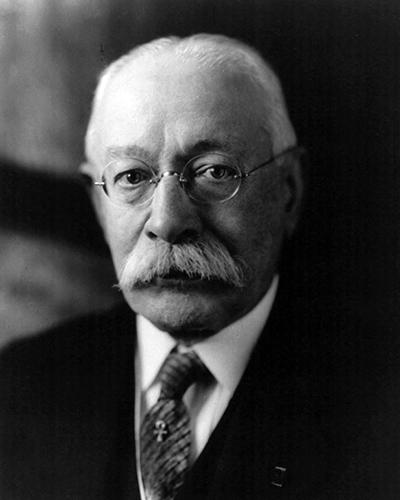
George W. Wickersham
President 1923-1936George Woodward Wickersham was unanimously elected President of ALI at the first Council meeting on February 24, 1923, and served as President until his death in 1936. From the beginning, he held a firm belief in the social usefulness of the Institute’s work.
In the first 13 years of the Institute’s organization, there were 13 Annual Meetings, 48 Council meetings, and 69 Executive Committee meetings. Wickersham was present at and presided over all of these meetings except those held in the spring of 1925, when he was in Europe serving as the sole representative of the United States on a committee of the Council of the League of Nations for the simplification and improvement of International Law, and in 1934 when he was confined to his house by illness for several months.
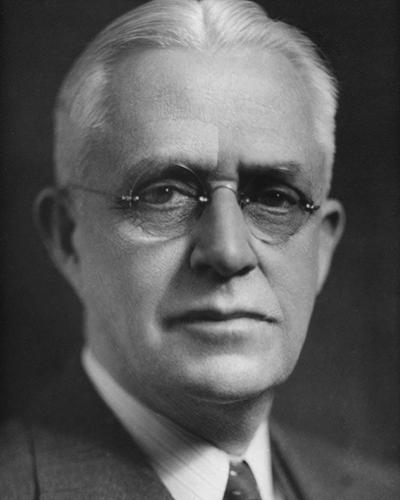
William Draper Lewis
Director 1923-1947“The relation between American judges, practitioners and teachers of law is closer and much more salutary than it was when he began his work. There was a quality in this man which stimulated friendship and aroused affection. I cannot at the moment think of any institution other than the Institute which was to so large an extent the expression of the personality of one man.” — George Wharton Pepper on the legacy of William Draper Lewis
If any one man can be credited with the creation of The American Law Institute, William Draper Lewis is unquestionably that man. It was he who first commended to Elihu Root a practicable plan for dealing with the indigestible mass of reported cases. And, when Root's endorsement had secured the necessary financial support, it was Lewis who, as ALI’s first Director, formulated and put into operation the plans which converted a dream into reality.
Lewis was the first full-time dean of the University of Pennsylvania, where he served in that role until 1914 and continued as member of the faculty until 1924.
For more than twenty years, Lewis familiarized himself with every phase of the Institute's work and no detail was small enough to escape his attention. In 1947, Lewis reluctantly resigned as Director of the Institute due to his failing health.
I have enjoyed my work as Director. Friends, in their kindness, tell me that the Institute owes much to me. Being human, such praise raises in me a knowledge of what the cat feels when he purrs. But I know that nothing I may have given to this Institute is a full return for that which the Institute has given me.
Long before the founding of the Institute, Lewis had developed a strong friendship and productive working relationship with George Wharton Pepper, who would later go on to become second president of ALI. In addition to serving as editors of the University of Pennsylvania Law Review (then known as the American Law Register and Review), in the late 1800s Lewis and Pepper worked together as editors of A digest of the laws of Pennsylvania from 1700 to 1894.
After his death in 1949, a piece honoring Lewis was featured in the University of Pennsylvania law Review, written by Pepper. Pepper’s work honoring his longtime friend is available here, courtesy of the University of Pennsylvania Law Review. George W. Pepper, William Draper Lewis, 98 U. PA. L. REV. 4 (1949).
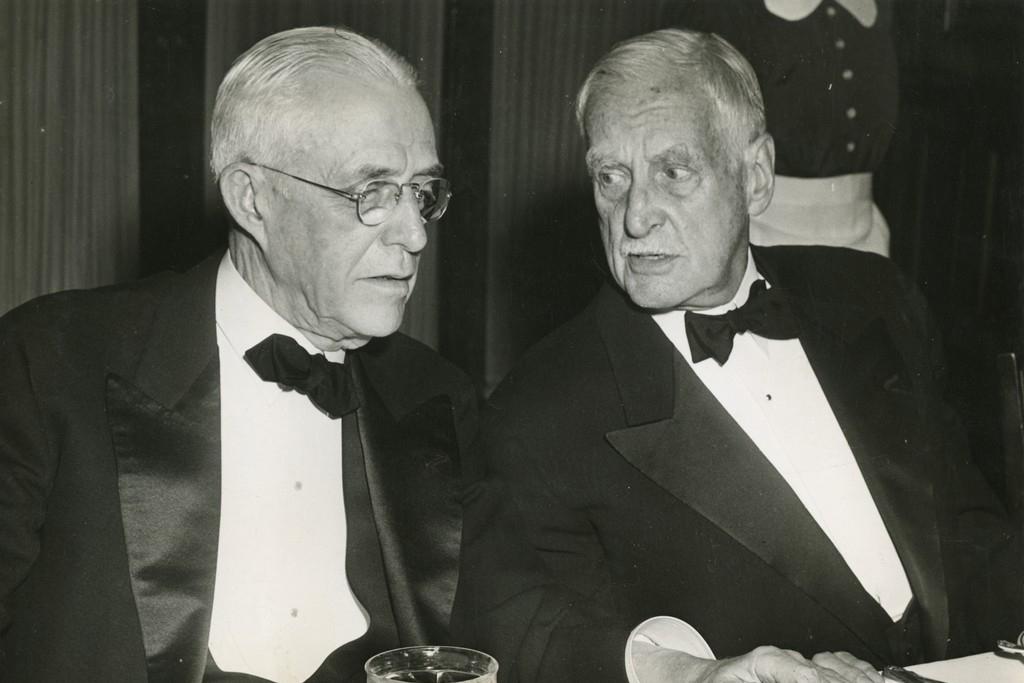
William Draper Lewis and George Wharton Pepper | Credit: University of Pennsylvania Archives
1936
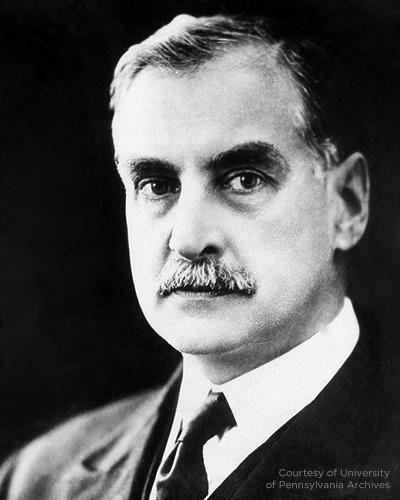
George Wharton Pepper
President 1936-1947A charter member of the Institute from its beginning, George Wharton Pepper became a Council member in 1930 and Vice President in 1932, succeeding Benjamin Cardozo when he was appointed to the U.S. Supreme Court. He then served as ALI’s second President from 1936 to 1947.
1947
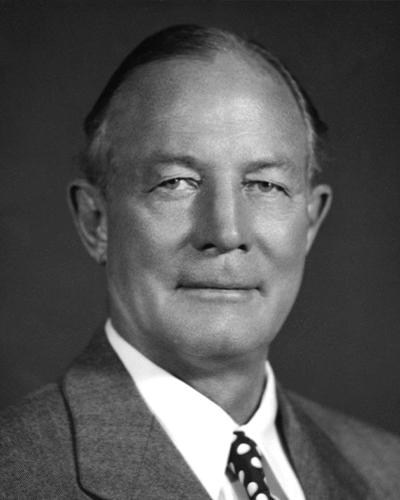
Harrison Tweed
President 1947-1961Harrison Tweed served as ALI’s third President from 1947 to 1961. He was elected in 1925 to life membership, only two years after ALI’s founding. Articulate, educated, and known for possessing a great deal of wit and humor, Tweed was an elemental force in the growth, development, and lasting legacy of the Institute.
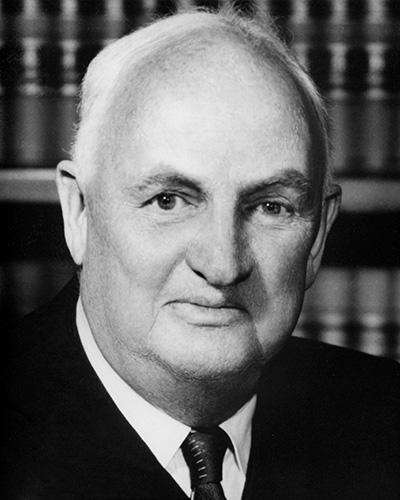
Herbert F. Goodrich
Director 1947-1962“To the extent which our work succeeds, we are making a contribution to justice according to law, about as fundamental a human value as we know. We must not lose it, even when the pressure of immediate demands makes it take, temporarily, a less conspicuous place.” — Herbert F. Goodrich
Herbert “Funk” Goodrich was the second Director of The American Law Institute from 1947 until his death in 1962.
Born in rural Minnesota in 1889, Herbert F. Goodrich made his way to Harvard Law and by the age of thirty he had become professor at the University of Iowa College of Law, then acting dean two years later. He then served for seven years as professor of law at the University of Michigan, before arriving in Philadelphia in 1929 as dean of the University of Pennsylvania Law School, where he remained for 11 years. During this time he became a leading citizen of the state. Offered the Attorney-Generalship, he declined, but on June 30, 1940 he resigned from Penn Law to accept an appointment on the U.S. Third Circuit Court of Appeals.
His work with ALI began at an Institute Conference held in Chicago in 1927. Goodrich, then living in Michigan, suggested that the several state bar associations produce annotations of each Restatement giving the pertinent decisions and statutes of their state. The suggestion was enthusiastically received and a number of state bar associations began the work.
As the project progressed, it became to work more directly with the individual state bar associations, to be sure that material was efficiently organized. Goodrich was appointed Adviser on Professional and Public Relations (later shortened to Director of Professional Relations) to fill this need. He served as the representative of the Institute in encouraging the organization of state bar committees and securing the manuscripts of the state annotations. By 1945, due in great part to Goodrich’s efforts, 126 separate annotations on different subjects had been published.
Goodrich became the second director of the Institute in 1947, succeeding William Draper Lewis. Much like his predecessor, he cooperated fully with every group of Advisers not only on Restatements but on all Institute projects. Particularly, he served as Chairman of the Editorial Board of the Uniform Commercial Code from the inception of that project until its completion; and when a Permanent Editorial Board for the Uniform Commercial Code was created by joint action of the Commissioners and the Institute, Goodrich became Chairman of that Board.
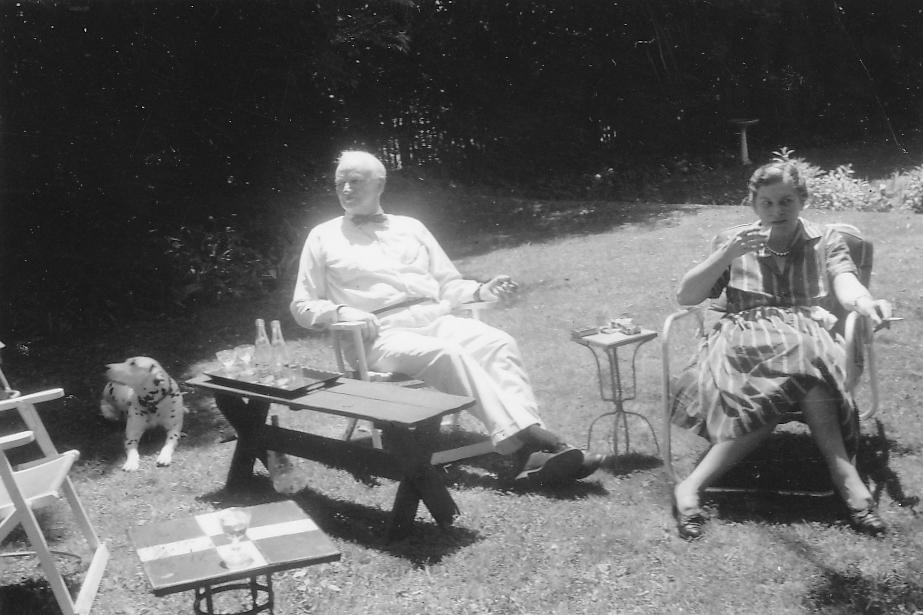
Goodrich with his wife Mary and their dalmatian, Daisy (photo courtesy of the Kalkstein Family)
Did You Know?
Goodrich served as both ALI Director and Third Circuit Judge until his death in 1962.
1961
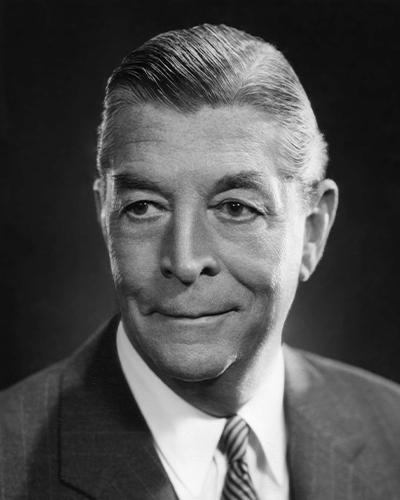
Norris Darrell
President 1961-1976Norris Darrell was elected to the Institute in 1947 and became its fourth President 14 years later. He graduated from the University of Minnesota Law School. Following graduation, he clerked for U.S. Supreme Court Justice Pierce Butler and joined the New York law firm Sullivan and Cromwell in 1925, with which he remained affiliated for more than sixty years.
1962
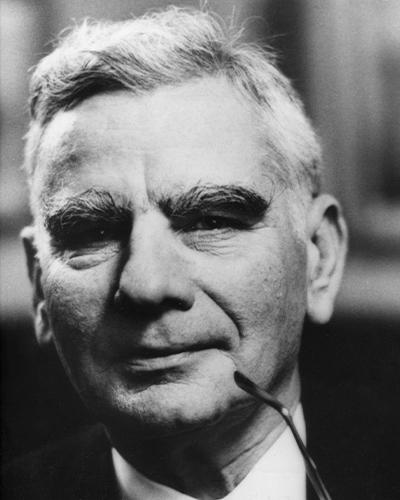
Herbert Wechsler
Director 1962-1984Herbert Wechsler served from 1963 to 1984 as the Institute’s third Director. Co-author of seminal casebooks that reshaped thinking about the federal courts and criminal law and author of the celebrated Holmes lecture at Harvard, “Toward Neutral Principles of Constitutional Law,” Wechsler also served as Chief Reporter for the Institute’s Model Penal Code during the decade that brought that highly influential project to its conclusion. Wechsler’s wife, Doris Wechsler, herself a lawyer and member of the Institute, often noted that he considered the Model Code his proudest achievement.
1976
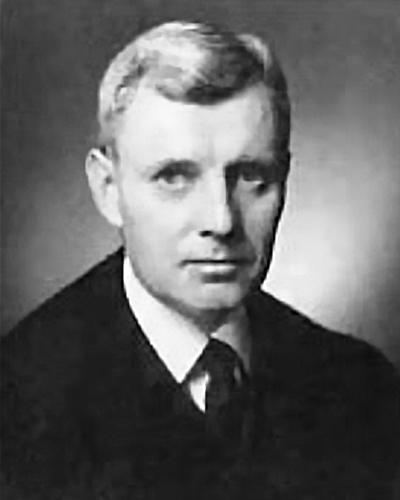
R. Ammi Cutter
President 1976-1980Richard Ammi Cutter served as ALI’s 5th President from 1976 to 1980. In addition to his role as president, he was an active ALI member for more than fifty years, holding numerous offices, and also served on numerous committees. Elected to the Institute in 1938 at the age of 36, he became a member of the Council of the Institute in 1949. Throughout his active and lengthy membership, Cutter served as an Adviser on many projects of the Institute, including the Restatement Second of Property; the Restatement Second of Conflict of Laws; and the Model Land Development Code.
These many years of devoted service prompted the Institute to name its First Reporter’s Chair for Ammi Cutter.
1980
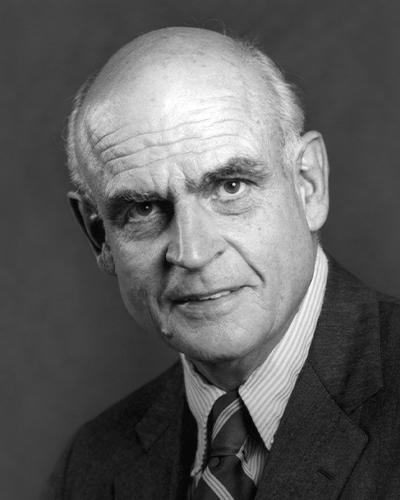
Roswell B. Perkins
President 1980-1993As ALI’s sixth president, Roswell B. Perkins was a guiding force and a tremendous influence on the legacy of the Institute. During his presidency he played a leading role in the development of the Principles of Corporate Governance: Analysis and Recommendations. An ALI member since 1964, he served on numerous projects and committees. In recognition of his years of service, ALI presented him with the Distinguished Service Award in 2008.
Perkins, a native of Boston, received his undergraduate and law degrees from Harvard University, where he was an editor of the Harvard Law Review. He retired from partnership in Debevoise & Plimpton in 2001, 52 years after joining the firm as an associate in 1949.
Following travel to Russia in 1985, Perkins spearheaded the inauguration of a Russian practice for the firm. Upon the decision of the firm to open an office in Moscow, Perkins relocated to Moscow in December 1997 to head up the new office, as Resident Partner of Debevoise in Moscow. He served in that capacity for three-and-a-half years, representing companies based in Russia, the U.S., UK, Europe, Scandinavia and the Far East. Among the projects included in the Russian practice of the firm in those years were project financings for three Russian oil refineries under U.S. Ex-Im Bank loan guarantee programs, two large investment funds targeted at Russia, joint ventures and extensive investment and general corporate activity.
Perkins’ ALI Presidency ended in 1993. The Institute’s Annual Report featured a tribute to Perkins by Erwin N. Griswold.
Did You Know?
In addition to his work at Debevoise, Perkins also served in the government, chiefly as Assistant Secretary of the newly created Department of Health, Education, and Welfare during the Eisenhower administration, and as Counsel to New York Governor Nelson A. Rockefeller.
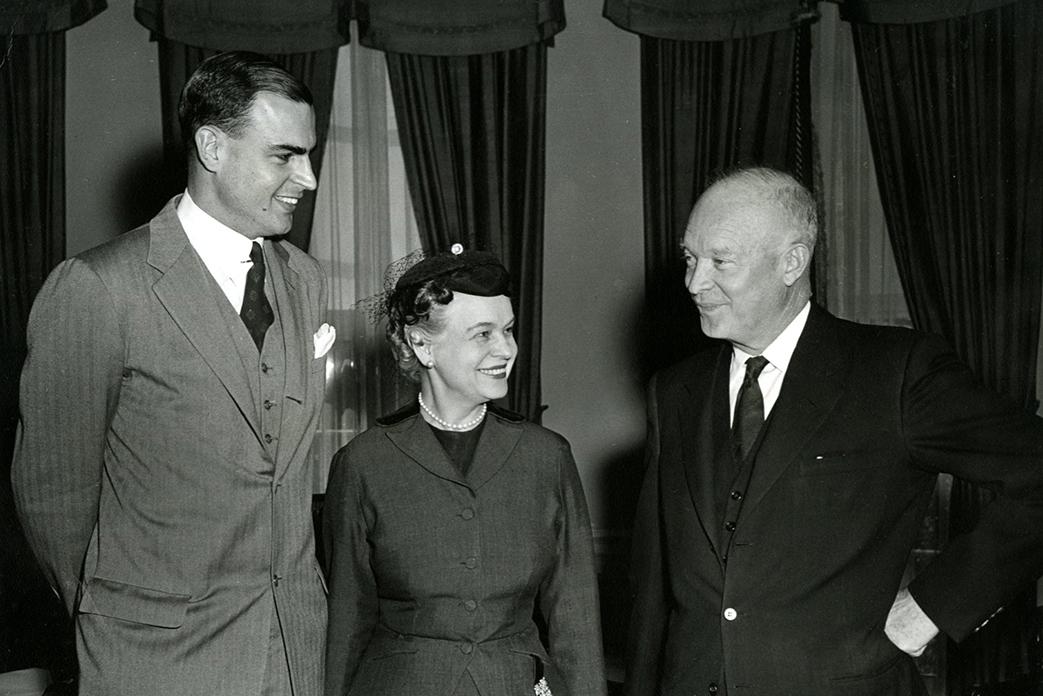
Perkins (left) with Oveta Culp Hobby, First U.S. Secretary of Health, Education, and Welfare, and President Dwight D. Eisenhower (1954) | Photo Credit: Abbie Rowe, Courtesy National Park Service
1984
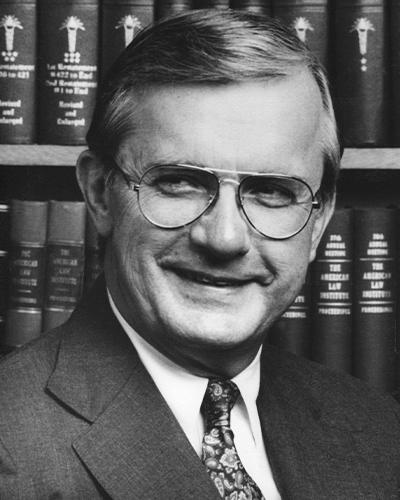
Geoffrey C. Hazard Jr.
Director 1984-1999An ALI member for 52 years, Geoffrey C. Hazard Jr. served for nine years as the Reporter for the Restatement Second of Judgments, published in 1982. The experience may have prompted his wry remark at the 1999 Annual Dinner that “qualifications for Reporter in an ALI project include good health and proven stamina.” He succeeded Herbert Wechsler as ALI’s fourth Director in 1984, skillfully guiding the ALI’s already-begun Principles of Corporate Governance and Restatement Third of Foreign Relations Law to completion. Many new ALI projects were begun under his leadership, including Restatement Third works on Agency, The Law Governing Lawyers, Property, Restitution, Suretyship, Torts, Trusts, and Unfair Competition; and Principles of the Law projects on Family Dissolution, Transnational Civil Procedure, and Transnational Insolvency. It was also during his tenure as Director that the Institute first turned its attention to projects with an international scope, a trend that continues today.
1993
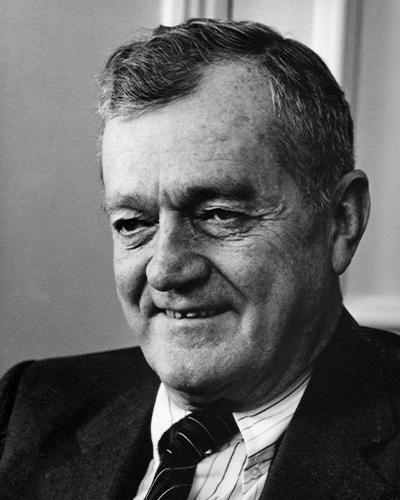
Charles Alan Wright
President 1993-2000Charles Alan Wright was a prominent professor, lawyer, and legal scholar who served as the seventh President of ALI from 1993 to 2000.
Wright was born on September 3, 1927, in Philadelphia. He graduated from high school at the age of 16 and went on to complete his undergraduate degree at Wesleyan University at the age of 18, before graduating from Yale Law School.
1999
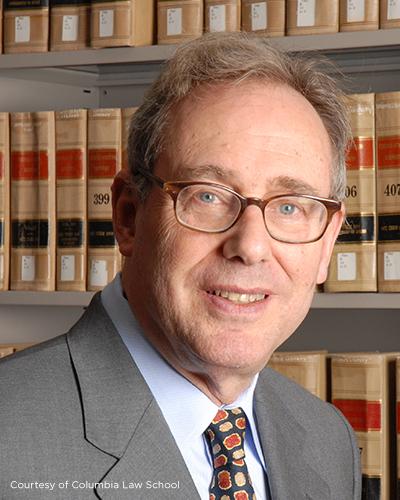
Lance Liebman
Director 1999-2014Lance Liebman served as ALI’s Director from 1999 to 2014. During his directorship, he oversaw a significant expansion of the Institute's work, as well as the development of ALI’s international partnerships, including with the European Law Institute. His commitment to ALI’s contribution to the international community continues today.
Restatement projects begun during his tenure include American Indian Law, Charitable Nonprofit Organizations, Consumer Contracts, Employment Law, Data Privacy, International Commercial and Investor-State Arbitration, three Torts projects (Economic Harm; Intentional Torts; and Physical and Emotional Harm), and Concise Restatement volumes on Law Governing Lawyers, Property (compiled by Liebman himself), and Torts.
Liebman retired in 2019 from Columbia Law School where he was the William S. Beinecke Professor of Law Emeritus and former Dean. Before joining Columbia in 1991 as Dean, Liebman was on the faculty of Harvard Law School for 21 years, becoming a full professor in 1976 and serving as Associate Dean from 1981 to 1984.
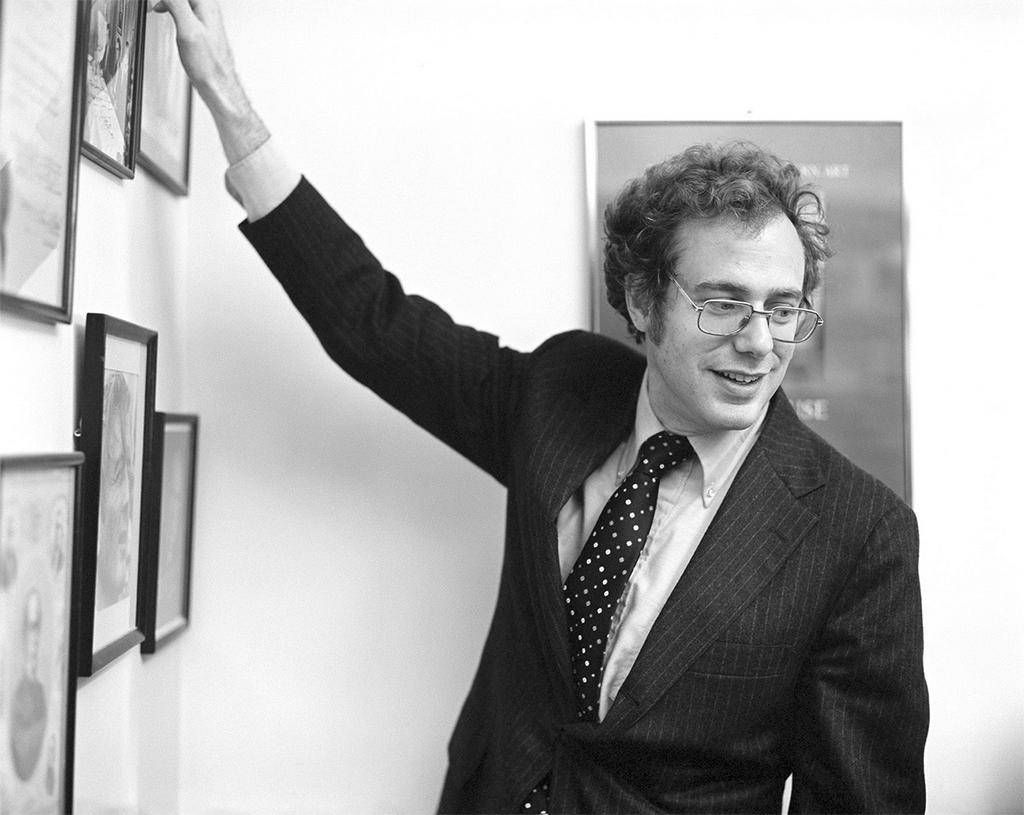
Chapin, C. (1979). Lance M. Liebman. | Credit: Harvard Law School Library, Historical & Special Collections
After serving as a law clerk to Justice Byron White of the U.S. Supreme Court, he spent two years working on transportation and community issues as an Assistant to Mayor John V. Lindsay of New York City.
He is a graduate of Yale University and Harvard Law School, and also holds a master’s degree from Cambridge University.
Liebman has been a Visiting Fulbright Professor of Law at Maharajah Sayajirao University in Baroda, India, a visiting lecturer at Tokyo University, and an adviser for the Japanese Institute of Labor. He also taught at the Harvard-Fulbright School in Ho Chi Minh City, Vietnam, and at the Hebrew University of Jerusalem, Israel.
The below video pays tribute to Liebman’s work as director, with remarks from ALI Council members.
Did You Know?
During Liebman’s tenure as Director, ALI completed 19 projects.
2000

Michael Traynor
President 2000-2008Michael Traynor served as ALI’s eighth President from 2000 to 2008, taking office after the sudden death of Charles Alan Wright. He is a recipient of ALI’s Distinguished Service Award.
Traynor has been an ALI member since 1972 and was elected to the Council in 1985. He has served as an Adviser for several ALI projects, including Restatement Third of Unfair Competition, both the Projects Liability and Apportionment of Liability segments of Restatement Third of Torts, the 1988 Revisions to the Restatement Second of Conflict of Laws, Restatement Third of Restitution, Restatement Third of Conflict of Laws, and Restatement Fourth of the Foreign Relations Law (Jurisdiction).
2008

Roberta Cooper Ramo
President 2008-2017Roberta Cooper Ramo has been an active member of ALI for more than 25 years. Elected to the Council in 1997, she served as First Vice President before being elected the first woman President of the Institute in 2008.
During her nine years as President, she brought a focus on diversity to ALI’s membership and Council election process, effectively bringing more women, minorities, and breadth of practice to the organization. As President, she is also credited with inspiring confidence and participation from all members of the Institute and collegiality through some of the most complex and controversial project discussions.
2014

Richard L. Revesz
Director 2014-2022Richard L. Revesz served as director from 2014 through 2022 and oversaw the completion of 16 projects, four of which were both initiated and completed during his tenure. In addition to these completed projects, the Institute had 13 ongoing projects launched by Revesz when he stepped down as director to assume the role of Administrator of the Office of Information and Regulatory Affairs.
Revesz was instrumental in changing the way that the Institute’s work is properly cited in The Bluebook. With ALI Council member Robert H. Sitkoff, Revesz met with the leadership of The Bluebook revisions, just as the 20th edition was close to completion, and The American Law Institute is now explicitly acknowledged as the institutional author of its works.
2017

David F. Levi
President 2017-2026David F. Levi is the 10th President of the Institute. Prior to his election as president, Levi was a life member of ALI and a member of its Council since 2003. He became ALI's President in May 2017.
Levi is the Levi Family Professor of Law and Judicial Studies and Director of the Bolch Judicial Institute at Duke University School of Law. He was previously the James B. Duke and Benjamin N. Duke Dean; the 14th dean of Duke Law School, he served from 2007 to 2018. Prior to this appointment, he was the Chief United States District Judge for the Eastern District of California with chambers in Sacramento. He was appointed United States Attorney by President Ronald Reagan in 1986 and a United States district judge by President George H. W. Bush in 1990.
2023

Diane P. Wood
Director 2023-PresentDiane P. Wood assumed the role of Director in May 2023, being the first woman to hold this position at the Institute. She was appointed to the U.S. Court of Appeals for the Seventh Circuit in 1995, and served as Chief Judge from 2013 to 2020. Wood assumed senior status in September 2022. She is also a Senior Lecturer in Law at the University of Chicago Law School, where she teaches in the areas of federal civil procedure, antitrust law, and international trade and business.
Before her appointment to the bench, Wood was the Harold J. and Marion F. Green Professor of International Legal Studies at the University of Chicago Law School. She also served for two years as Deputy Assistant Attorney General in the Antitrust Division of the U.S. Department of Justice, with responsibility for the Division’s international, appellate, and legal policy matters. In 2015, Wood received the U.S. Department of Justice’s 2015 John S. Sherman Award—the department’s highest antitrust honor.
2026
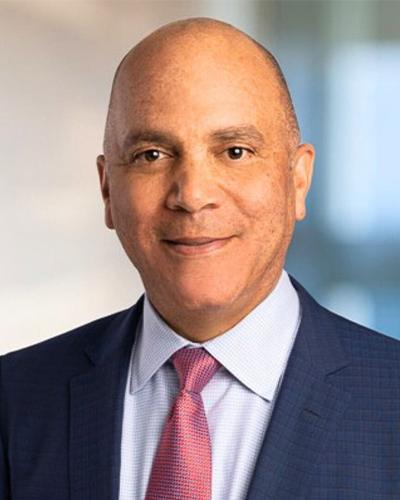
Wallace B. Jefferson
President 2026-PresentWallace B. Jefferson is the 11th President of the Institute. He served on the Supreme Court of Texas from 2001 to 2013 and was Chief Justice from 2004 until the end of his tenure. He made Texas history as the Court’s first African American Justice and Chief Justice. During his time on the bench, he led efforts to expand access to justice, supported reforms to juvenile justice, and oversaw the implementation of a statewide electronic filing system for Texas courts. He also served as President of the Conference of Chief Justices, representing chief justices from all 50 states and U.S. territories.
1932
The Restatement of the Law of Contracts, which deals with the legal relations between parties to promises and remedies available when a promise is broken, was approved by the Institute in May 1932, the first Restatement to be finished. With Samuel Williston as Reporter and Arthur L. Corbin as Special Adviser and Reporter on Remedies, the work was a legendary success, exercising enormous influence as an authoritative exposition of the subject.
In the nine years during which the work on Contracts was moving forward there were 34 conferences of the Reporters and Advisers each from three to seven days duration, and 51 preliminary drafts were considered. The Council considered 17 Final Preliminary Drafts and submitted Tentative Drafts of various parts of the work for consideration and discussion to eight Annual Meetings.
Reporters
Samuel Williston
Arthur L. Corbin (Remedies)
President at Publication
George W. Wickersham
Elihu Root (Honorary President)
Director at Publication
William Draper Lewis
Did you know?
In September 1928, a revision of the first 177 Sections was published as a Preliminary Official Draft. A majority of these drafts were used by the courts, by practitioners, and in law schools for more than three years prior to the official text being approved.
1933
The Restatement of Agency deals with the relations between principal and agent, principal and third-person, and agent and third-person.
In addition to stating the rules that exist where there is a relationship of agency, the Restatement deals also with cognate situations which have legal consequences similar to those characteristic of the agency relationship. Thus, it states not only the legal relations which result where an agent exceeds his authority but those which result both before or after ratification when one who is not an agent purports or assumes to act as such.
It includes also the termination of powers given as security that, although existing in the form of agency powers, do not involve an agency relationship because of the absence of a duty by the power holder to act for the benefit of the one granting the power.
Reporters
Floyd R. Mechem (1923-1928)
Warren A. Seavey
President at Publication
George W. Wickersham
Elihu Root (Honorary President)
Director at Publication
William Draper Lewis
Mechem died on December 11, 1928. He was eulogized by George W. Wickersham at the 1929 Annual Meeting. William Draper Lewis, stated that despite his age, Mechem “threw himself into his difficult task with that nervous energy which had enabled him to accomplish so much during his professional career.”
1934
It took eleven years to complete the Restatement of the Law, Conflict of Laws. The subject presented very special difficulties, mainly due to the fact that the legal importance of the subject had yet to be recognized. In the appointment of Joseph H. Beale, the Institute chose a Reporter who had already devoted more than thirty years to the study and exposition of the subject.
Although many, including Beale, had been teaching this subject matter for several years before ALI took on this project, instruction on the subject had been far from universal. There had not been a general long-continued critical study of this subject as had been given to other principal subjects of common law. Because of this lack of instruction, when confronted with questions of conflict of laws, courts did not bring to their solution an adequate background of knowledge. As a consequence, the opinions accompanying their decisions were not as clear as in other fields of law.
Additionally, conflict of laws necessarily involves every branch of the law. Therefore, accurate expression of its rules involved extended consultation with the Reporters for the other Restatement projects.
Reporters
Joseph H. Beale
Herbert F. Goodrich (Administration)
President at Publication
George W. Wickersham
Elihu Root (Honorary President)
Director at Publication
William Draper Lewis
Did You Know?
All of the work on the Tentative Drafts, except that covering the Chapter on Administration, was completed in the first part of 1929. The revision of the Tentative Drafts had begun, and the results of these revisions were considered by the Institute at the Annual Meetings in 1930 and 1931. The second revision, as well as the completion of the Chapter on Administration, was submitted to the Annual Meeting in 1934 as a Proposed Final Draft of the subject with a recommendation for its adoption.
The Restatement of the Law of Torts was separated into four volumes and published from 1934 to 1939. The first volume of the Restatement contains Division One of this subject relating to intentional harms to persons, land, and chattels.
Reporters
Francis H. Bohlen
Edward S. Thurston (Chapters 7 and 8)
Fowler V. Harper (Chapters 9 and 10)
President at Publication
George W. Wickersham
Elihu Root (Honorary President)
Director at Publication
William Draper Lewis
Did You Know?
Prior to his appointment to the Supreme Court of the United States in February 1932, ALI Council member Benjamin N. Cardozo attended a very considerable number of the conferences relating to the subject-matter of this Volume and that relating to the law of negligence.
The Restatement of the Law of Torts was separated into four volumes and published from 1934 to 1939. The second volume of the Restatement contains Division Two of this subject relating to negligence.
Reporter
Francis H. Bohlen
President at Publication
George W. Wickersham
Elihu Root (Honorary President)
Director at Publication
William Draper Lewis
1935
Annotated from the 1935 Introductory Note:
A trust is one of several devices whereby one person is enabled to deal with property for the benefit of another person. Among other such devices are bailment, guardianship and agency. These latter devices are to be found in all mature systems of law; the trust is a peculiar product of the Anglo-American system. The principles, rules, and standards of the law of trusts owe their origin and development in large part to the fact that in England there were for centuries separate courts of common law and chancery, to which is due the distinction between legal interests and equitable interests, which is the basis of the law of trusts.
Although in many respects the courts have dealt with equitable interests as they have dealt with legal interests, there has always been less rigidity in their treatment of equitable interests. One of the most important characteristics of the trust is its flexibility. The trust may be employed for many purposes for the accomplishment of which a limitation of legal interests would be impossible or impracticable. The trust may be used not only for family settlements and for the disposition of decedents’ estates, but it may be used in many kinds of commercial transactions.
In the origin of trusts and of uses out of which the modern trust has developed, the emphasis was laid on the personal relation; but in the course of time the emphasis has shifted and is now laid on the aspect of a trust as a disposition of property. The fact, however, that the trust has these two aspects makes it desirable to treat it as a separate subject, though allied with the subject of property.
Reporter
Austin W. Scott
President at Publication
George W. Wickersham
Elihu Root (Honorary President)
Director at Publication
William Draper Lewis
Did You Know?
When the work on Trusts begun it was proposed to include constructive trusts. It was determined, however, that the rules applicable to constructive trusts, except so far as they arise out of express trusts or attempts to create express trusts, should not be dealt within the Restatement of Trusts, but should be dealt with in a separate Restatement of Restitution and Unjust Enrichment, which would include, among other things, rules ordinarily dealt with under quasi contracts or under constructive trusts.
1936
The law of property constitutes a substantial fraction of all American law, requiring a five volumes and years of work to complete this Restatement. Volumes One and Two, published in 1936, embrace general matters of terminology; the creation and general characteristics of freehold estates; and the large body of material stating the characteristics of future interests.
These areas of property law were addressed first either because they were of underlying and widely pervasive importance throughout the entire subject or because they were aspects of the subject in which the clarifying and simplifying process of restatement was particularly needed.
Reporters
Richard R. Powell
Harry A. Bigelow (1927-1929)
Special Reporter
W. Barton Leach (Chapter 15)
President at Publication
George Wharton Pepper
Elihu Root (Honorary President)
Director at Publication
William Draper Lewis
Did You Know?
This work includes monographs, prepared by Powell and published under the authority of ALI’s Council, that apply to Sections of the Restatement where the rule of law stated is “contrary to an impression believed to be widely entertained by the profession.”
1937
The Restatement of the Law of Restitution deals with situations in which one person is accountable to another on the ground that otherwise s/he would unjustly benefit or the other would unjustly suffer loss. This Restatement treats as one coherent subject principles, rules, and remedies applicable to restitution as they have been developed through actions at law and proceedings in equity.
It is divided into two parts. Part I is more extensive than that which the profession has seen treated under the title, “Quasi Contracts,” in that it deals with all situations in which there is a right to restitution enforced either by action at law or by a proceeding in equity. Part II deals with matters customarily treated under the title “Constructive Trusts,” and includes situations in which as a result of his/her right to restitution a person is entitled to obtain a specific thing or fund, to have a lien established thereon, or to be subrogated to the claim of another.
Reporters
Warren A. Seavey (Part I)
Austin W. Scott (Part II)
President at Publication
George Wharton Pepper
Director at Publication
William Draper Lewis
Did You Know?
During the work on the Preliminary Drafts and the revision of the Tentative Draft the committee held twenty-eight conferences, lasting from three to four days each.
1938
The third volume of the Restatement of the Law of Torts contains the official draft of Divisions Three to Nine; those relating to absolute liability, deceit, defamation, disparagement, unjustifiable litigation, interference in domestic relations, and interference with business by trade practices. The sections relating to these divisions were approved in 1937, except the sections relating to interference in domestic relations and interference with business by trade practices, which were approved in 1938.
Reporters
Francis H. Bohlen
Harry Shulman (Division 9)
Associate Reporter
Fowler V. Harper (Division 5, 6, 8)
President at Publication
George Wharton Pepper
Director at Publication
William Draper Lewis
1939
The fourth and concluding volume of Restatement of the Law of Torts contains the final sections in Division Nine and Divisions Ten to Thirteen of the subject. The matters treated are interference with business relations by trade practices, by refusal to deal or inducing others to refuse to deal with another generally and in the course of labor disputes, invasions of interests in the private use of land, and tortious conduct not previously fully dealt with; also defenses applicable to all tort claims. The thirteenth and last division deals with damages and injunctions.
At the time of completion, the four-volume Restatement of Torts covered a much wider field than any other subject undertaken for Restatement except the law of property. Not lacking unity, it nevertheless included many divisions dealing with wrongful and privileged interferences with distinct types of interests.
Reporters
Francis H. Bohlen
Harry Shulman (Division 9)
Everett Fraser (Division 10)
Warren A. Seavey (Divisions 11, 12, and Chapter 47 of Division 13)
Edgar N. Durfee and Maurice T. Van Hecke (Division 12, Chapter 48)
President at Publication
George Wharton Pepper
Director at Publication
William Draper Lewis
Did You Know?
Forty-one Reporters and Advisers were members of the different Torts groups. Besides the Reporter, Francis H. Bohlen, the Torts Restatement included seven Reporters for different divisions or chapters: Edgar N. Durfee, Everett Fraser, Fowler V. Harper, Warren A. Seavey, Harry Shulman, Edward S. Thurst, and Maurice T. Van Hecke.
1940
Volume III of this Restatement concludes the work begun in Volume II on future interests.
Parts I and II on the topic of future interests, found in Volume II, designate and differentiate the recognized types of future interests and state their characteristics. This third volume deals with problems of construction and the special topics of interests of expectant distributees and powers of appointment.
Reporter
Richard R. Powell
Special Reporter
W. Barton Leach (Chapter 25)
Associate Reporter
A. James Casner (Chapter 23)
President at Publication
George Wharton Pepper
Director at Publication
William Draper Lewis
1941
This Restatement is divided into two parts. Division I deals with personal property as Security; Division II with Suretyship.
Division I is limited to pledges and possessory liens. Statutory liens and equitable security interests are not separately treated but incidental reference to statutory liens is made at appropriate points and various equitable security interests are considered in connection with other topics.
Chattel mortgages, conditional sales, trust receipts, and security interests in land are not included in this Restatement.
Reporter
John Hanna
President at Publication
George Wharton Pepper
Director at Publication
William Draper Lewis
1942
In 1939, the Council approved the project to begin under the guidance of Reporter Edmund M. Morgan of Harvard Law School and an Adviser committee that included Learned Hand of the U.S. Court of Appeals for the Second Circuit.
In the Introduction to the Code, ALI Director William Draper Lewis noted that a “thorough revision of existing law” was needed. At the time, it was a tremendous undertaking for ALI. As Director Lewis noted, “the Rules themselves in numerous and important instances are so defective that instead of being the means of developing truth, they operate to suppress it.”
Although it was a pioneering work at the time, the Model Code of Evidence is not itself cited today. Rather, its legacy is cemented in its influence on the Federal Rules of Evidence, originally enacted in 1975, including in areas such as “Hearsay” and “Summing Up and Comment by Judge.” In the Letter of Submission to the Chairman of the Standing Committee on Rules of Practice and Procedure, Judicial Conference of the United States, Albert E. Jenner Jr., Chairman of the Advisory Committee on Rules of Evidence wrote, “The Committee acknowledges its indebtedness to its predecessors in the field of drafting rules of evidence. The American Law Institute Model Code of Evidence, Uniform Rules of Evidence, New Jersey Rules of Evidence, and California Evidence Code, with their supporting studies and commentaries, were invaluable in suggesting general approaches and organization as well as particular solutions.”
The Federal Rules of Evidence govern the introduction of evidence at civil and criminal trials in federal courts, and many states have adopted (with or without alteration) the Federal Rules.
Reporter
Edmund Morgan
Assistant Reporter
John M. Maguire
President at Publication
George Wharton Pepper
Director at Publication
William Draper Lewis
Did You Know?
In 1939, the Carnegie Corporation granted the Institute $40,000 to work on the Model Code of Evidence.
The Restatement of Judgments is concerned with questions as to the validity of judgments and as to their effect on subsequent controversies. Matters relating to the effect of a judgment in states other than that in which the judgment is rendered are dealt with to some extent in the Restatement of Conflict of Laws. The Restatement of Judgments deals primarily with the effect of a judgment in the state in which it was rendered, and only incidentally with the effect in other states.
Reporters
Austin W. Scott
Warren A. Seavey
Assistant Reporter
Erwin N. Griswold
President at Publication
George Wharton Pepper
Director at Publication
William Draper Lewis
Did You Know?
The Carnegie Corporation donated $30,000 for work on the Restatement of the Law of Judgments.
1945
The Volume IV of the Restatement of the Law of Property contains the Division on social restrictions imposed upon the creation of property interests.
It deals with the common law rule against perpetuities (including an Appendix on the statutory rules in New York, the District of Columbia and twelve other states); restraints on alienation, provisions in restraint of marriage; no contest and allied provisions in wills; miscellaneous restraints; and the rule against accumulations.
Reporter
Richard R. Powell
Special Reporter
A. James Casner (Chapters 29-30)
Assistant Reporter
Julian S. Bush
President at Publication
George Wharton Pepper
Director at Publication
William Draper Lewis
Did You Know?
James Casner served as Special Reporter until June 1942, when he entered the military service of the United States and served as a Colonel in the service overseas.
Volume V of the Restatement of Property, the final Volume in this Restatement series, covers servitudes, which deals with easements, licenses and promises respecting the use of land. Volume V of the Restatement of Property was the last volume to be published in the Institute’s first Restatement of the Law series.
Reporter
Oliver S. Rundell
President at Publication
George Wharton Pepper
Director at Publication
William Draper Lewis
Did You Know?
From 1922 to 1948, the Carnegie Corporation supported the ALI’s work with eight grants totaling $2,744,196.90—more than $25 million in current dollars. This funding enabled ALI to produce additional Restatements in the areas of Property, Restitution, Judgments, and Security.
1958
The Restatement Second of Agency became one of the two first subjects addressed after it was announced that work on the Restatement Second series would begin (the other being Trusts).
The first reason for taking on the topic again was that there had been no thorough consideration of the subject since the appearance of the first edition in 1933. There had been a flow of decisions over a quarter of a century in a developing field of law.
The second was that the Institute could have the services of Warren A. Seavey, who completed the first edition of the Restatement following the death of Floyd Mechem.
The Restatement Second is now out of print and has been completely superseded by Restatement Third of Agency.
Reporter
Warren A. Seavey
President at Publication
Harrison Tweed
Director at Publication
Herbert F. Goodrich
Did You Know?
The three-volume set of Agency Second was priced at $36.00.
1959
The two-volume Restatement Second of Trusts was the second work completed in the Restatement Second series.
While not much of the law changed since the publication of the first Restatement of Trusts, the breadth of the subject of Trusts was growing, including applications of established principles to new situations. The effort in Trusts Second, as in other subjects being dealt with in the new Restatement, was to provide fuller explanations for conclusions reached.
Reporter
Austin W. Scott
President at Publication
Harrison Tweed
Director at Publication
Herbert F. Goodrich
Did You Know?
In this work’s Introduction, Director Herbert Goodrich expounds on the history of ALI’s work on and the future of the subject of Trusts.
1962
The Model Penal Code, completed in 1962, played an important part in the widespread revision and codification of the substantive criminal law of the United States. The original publication of the Model Code consisted only of the thirteen Tentative Drafts, containing different portions of the text and accompanying Comments, that were considered by the Institute from 1953 to 1960; an initial Final Draft, containing revised text on responsibility, sentencing and correction, considered in 1961; and the Proposed Official Draft of the entire Code (without Comments) approved and promulgated in 1962.
A decade later, when twenty-four states had enacted portions of the new codes and legislation was in prospect in some other states, the time for undertaking final publication was believed to be at hand. A grant from the Law Enforcement Assistance Administration made the project possible and R. Kent Greenawalt was appointed Chief Reporter.
Three volumes, containing Part II of the Model Code, Definition of Specific Crimes, with revised Comments drafted by Peter W. Low as Reporter and John Calvin Jeffries Jr. as Associate Reporter, were published in 1980. Three more volumes, containing Part I of the Code, General Provisions, with revised Comments drafted by Greenawalt, Low and Malvina Halberstam (Article 1), with the assistance of Sanford Fox (Articles 6 and 7) were published in 1985.
In the course of the revision of the commentaries, it became evident that a final, official publication of the complete text of the Model Penal Code would be of value. The proposed statutory formulations are accompanied by brief explanatory notes and references to the volume and page of the revised Commentaries (or, with respect to Parts III and IV of the Code, the Tentative Drafts) where detailed exposition will be found. The Explanatory Notes were prepared by Greenawalt and his associates in the course of their revision of the Comments. Unlike the statutory text, which had the Institute’s approval after a decade of consideration by the Council and Annual Meetings of the members, the notes and commentaries are the work of the Reporters.
Reporters
Herbert Wechsler
Louis B. Schwartz
Associate Reporters
Morris Ploscowe (Tentative Draft No. 2, Articles 5, 7, 301)
Paul W. Tappan (Sentencing and Treatment of Offenders; Organization of Correction)
President at Publication
Norris Darrell
Director at Publication
Herbert F. Goodrich
Did You Know?
By the time the Commentaries were published in 1985, thirty-four states had already enacted new codes based on the Model Penal Code.
1965
The Foreign Relations Law of the United States includes portions of international law, as that term is used to describe the legal aspects of relations between nations, and that part of the domestic law of the United States that is involved in the conduct of the foreign relations of the United States, including constitutional law and some portions of conflict of laws.
A major exclusion is the area relating to war or hostilities, except where it is appropriate to consider the effect upon a rule applicable in time of peace. Also excluded are the areas of acquisition of territory and the United States law of nationality.
The rules stated in the publication are divided into four parts:
I. Jurisdiction
II. Recognition
III. International Agreements
IV. Responsibility of States for Injuries to Aliens
In 1955, ALI held a three-day conference to discuss a possible project in foreign relations law. At this special conference, attendees discussed six general fields of study in which it was recommended that ALI could profitably undertake and publish.
Reporter
Adrian S. Fisher
Associate Reporters
Covey T. Oliver
Cecil J. Olmstead
I.N.P. Stokes (Reporter for Part IV)
Joseph M. Sweeney
President at Publication
Norris Darrell
Director at Publication
Herbert Wechsler
Did You Know?
The Restatement is credited by some to have created the field of law “Foreign Relations Law.”
Volumes One and Two of the Restatement Second of Torts deal with the topics of intentional harms and negligence. They were approved by the Institute in 1963; an amendment of § 402A was additionally authorized in 1964. They supersede the first two volumes of the original Restatement, which are concerned with the same subjects.
Reporter
William L. Prosser
President at Publication
Norris Darrell
Director at Publication
Herbert Wechsler
Did you know?
Reporter Prosser’s first Preliminary Draft was ready for an Advisory meeting in September 1955, and discussion with Advisers was completed for the whole revision in the fall of 1962.
1969
The current importance of the issue of the limits of federal judicial power was brought to the attention of the Institute by Chief Justice of the United States Earl Warren in his opening address to the Annual Meeting in May 1959. Noting “the constant upward trend in the total volume” of cases filed in the United States District Courts and the pendency in Congress of proposals to abolish or curtail the federal jurisdiction based upon diversity of citizenship, the Chief Justice observed that it “is essential that we achieve a proper jurisdictional balance between the Federal and State court systems, assigning to each system those cases most appropriate in the light of the basic principles of federalism.” To that end, lie expressed the hope “that the American Law Institute would undertake a special study and publish a report defining, in the light of modern conditions, the appropriate bases for the jurisdiction of Federal and State courts.”
A grant from the Ford Foundation, following a preliminary study by Professor Charles Bunn of the University of Virginia School of Law, made it possible for the Institute to act on this suggestion.
Reporter
Richard H. Field
Associate Reporters
Paul J. Mishkin (General Diversity and Multi-Party Multi-State Jurisdiction)
Charles Alan Wright (Federal Question Jurisdiction)
Assistant Reporter
David L. Shapiro
President at Publication
Norris Darrell
Director at Publication
Herbert Wechsler
Did You Know?
Congress determined by the Judiciary Act of 1789 to establish federal courts of original jurisdiction and the scope to be accorded to that jurisdiction.
1971
This Restatement addresses the specific problems that arise when a case is connected with more than one jurisdiction. Topics include personal jurisdiction as well as the recognition, effect, and defense of foreign judgments. A 17-year effort, this work entirely supersedes the original Restatement on this subject, published in 1934.
In the published work’s Introduction, Director Herbert Wechsler highlights how the Restatement Second’s treatment of this subject has developed from the original Restatement:
[W]hat is presented here is a fresh treatment of the subject. It is a treatment that takes full account of the enormous change in dominant judicial thought respecting conflicts problems that has taken place in relatively recent years. The essence of that change has been the jettisoning of a multiplicity of rigid rules in favor of standards of greater flexibility, according sensitivity in judgment to important values that were formerly ignored. Such a transformation in the corpus of the law reduces certitude as well as certainty, posing a special problem in the process of restatement. Its solution lies in candid recognition that black-letter formulations often must consist of open-ended standards, gaining further content from reasoned elaboration in the comments and specific instances of application given there or in the notes of the Reporter. That technique is not unique to Conflicts but the situation here has called for its employment quite pervasively throughout these volumes. The result presents a striking contrast to the first Restatement in which dogma was so thoroughly enshrined.
Reporter
Willis L. M. Reese
Associate Reporter
Austin W. Scott
President at Publication
Norris Darrell
Director at Publication
Herbert Wechsler
Did You Know?
In light of significant legal developments on this subject since the Restatement Second’s publication in 1971, the Institute is currently working on the Restatement of the Law Third, Conflict of Laws.
1972
This work integrated Supreme Court decisions on police practices and criminal procedure with developing knowledge and views about sound law enforcement and criminal administration.
In 1966, weeks after ALI membership voted to approve Tentative Draft No. 1—which addressed investigation and questioning after arrest and prior to appearance before a judicial officer—the Supreme Court of the United States delivered its opinion in Miranda v. Arizona, changing the landscape of custodial interrogations in the United States. As a result of Miranda, ALI needed to make a decision on how to update the already approved black letter: integrate Miranda into the Model Code, or wait-and-see how Miranda would unfold in application. ALI chose the latter approach.
Chief Reporter
James Vorenberg
Reporters
Paul M. Bator
Charles Fried
Telford Taylor
Associate Reporters
Edward L. Barrett Jr.
Arnold N. Enker
President at Publication
Norris Darrell
Director at Publication
Herbert Wechsler
Did You Know?
In October 1966, ALI Council held a meeting to discuss how to move forward with this project in light of Miranda. In preparation for this the meeting, the Reporters prepared a Report for Council laying out the different ways Miranda may affect portions of the Model Code and whether adjustments regarding the scope of the project were necessary.
1976
This work coordinates and integrates state legislation intended to control or influence the development of land. The Code’s scope includes the distribution of authority between the state and local governments and the extent to which a formal plan should be prerequisite to regulation.
Chief Reporter
Allison Dunham
Associate Reporter
Fred P. Bosselman (from Mar. 1969)
Assistant Reporters (to Mar. 1969)
Ira Michael Heyman
Jan Z. Krasnowiecki
Terrance Sandalow
President at Publication
R. Ammi Cutter
Director at Publication
Herbert Wechsler
1977
This two-volume work is a comprehensive collection of the law surrounding the landlord–tenant relationship. It covers tenants’ rights and remedies, landlords’ rights and remedies, transfers of interest, tort liability, and federal bankruptcy proceedings.
Reporter
A. James Casner
President at Publication
R. Ammi Cutter
Director at Publication
Herbert Wechsler
Did You Know?
The A. James Casner Reporter’s Chair was established to honor the memory of Casner, who, as a Reporter and Adviser for various ALI projects for over half a century, made profound contributions to the development of the law of property, the taxation of trusts and estates, and estate planning.
Released more than a decade after Volumes One and Two, Volume Three supersedes the corresponding Sections in the first Restatement and adds new topics, including privacy and its invasion as a tort.
One reason for Volume Three’s delay in approval was that the law of defamation and of privacy had been in flux to a significant degree at the time, as the Supreme Court was grappling with the implications in this area of the freedom protected by the First Amendment. The magnitude of the uncertainty involved had also been noted by Prosser, who had asked in 1966 and 1967 that portions of his drafts on defamation and on privacy be tabled until new Supreme Court doctrine had been clarified by subsequent decisions.
In 1974, John Wade, who took over as Reporter after Prosser’s resignation, considered that the time had come to express, so far as the Institute could do so, where the law of these subjects stood. Working with a large group of Advisers newly convened for the purpose, submissions were developed and reported in 1974 and 1975, resulting in approval of the text presented in Volume Three.
Reporters
William L. Prosser (to June 1970)
John W. Wade (as of June 1970)
President at Publication
R. Ammi Cutter
Director at Publication
Herbert Wechsler
Did You Know?
Prosser, the original Reporter, resigned in 1970 and died in 1972. At the time of his resignation he had prepared drafts for the entire subject that had been reviewed by the project’s Advisers. Much of this material had not, however, been presented to the Council or the Institute or, if presented, was in process of revision. Hence, when Wade responded to the Council’s urgent request to assume the reportorial responsibility, he faced the large task of reviewing the outstanding Prosser drafts, rewriting, supplementing, or revising as required in each case.
1979
This Volume completes the official text and comments of Restatement Second of Torts, superseding the original Restatement of this subject published in the years from 1934 to 1939.
There were two notable changes in how the Restatement Second covered certain topics compared to their coverage in the first Restatement. First, several Chapters in Division Nine, concerning trade practices and labor disputes, were omitted in the view that these topics have become substantial specialties in their own right, governed extensively by legislation and largely divorced from their initial grounding in the principles of torts.
Second, there was a significant expansion in the treatment of other subjects in this Volume, notably nuisance and riparian rights in Division Ten; tort actions derived by implication from criminal statutes (§ 874A); contribution and indemnity in Division Eleven, consent and the new chapter (45A) on immunities in Division Twelve; and remedies, especially injunctive relief, in Division Thirteen.
Reporters
William L. Prosser (to June 1970)
John W. Wade (as of June 1970)
Associate Reporter
Frank J. Trelease (Chapter 41)
President at Publication
R. Ammi Cutter
Director at Publication
Herbert Wechsler
Did you know?
It took a quarter of a century of effort to order, articulate, and appraise the content of this significant, developing, and fascinating area of law.
1980
This work is a revision and integration of six federal laws relating to securities. Its principal aims are to simplify a complex body of law, eliminate duplicate regulation, and reexamine the entire scheme of investor protection with a view to increasing its efficiency.
Reporter
Louis Loss
Assistant Reporter
Victor Brudney (Part XIV)
President at Publication
R. Ammi Cutter
Director at Publication
Herbert Wechsler
1981
Work on the Restatement Second of Contracts began in 1962 and was completed by the Institute in 1979. During the intervening years, fourteen Tentative Drafts, the first of which appeared in 1964, were submitted for consideration. Contracts was thus on the agenda of the Annual Meetings in every year but two from 1964 through 1979.
Robert Braucher served as Reporter for approximately the first half of this period, resigning on his appointment to the Supreme Judicial Court of Massachusetts in January 1971.
Reporters
Robert Braucher (to 1971) (Chapters 1-5, 9 [Topics 1-4], 13-15)
E. Allan Farnsworth (as of 1971) (Chapters 6-8, 9 [Topic 5], 10-12, 16)
President at Publication
Roswell B. Perkins
Director at Publication
Herbert Wechsler
Did You Know?
The Uniform Commercial Code inspired a number of significant additions. In fact, the official text includes a UCC Table that shows where Sections of the UCC are cited in the Restatement.
1982
The Restatement Second of Judgments deals with the preclusive effects of judgments in civil actions. “Preclusive effects” refers to limitations on the opportunity in a second action to litigate claims or issues that were litigated, or could have been litigated, in a prior action. In general terms, these limitations include the rules of claim preclusion and issue preclusion and the concept of “privity.”
There had been momentous changes in the 40 years since the first Restatement: the simplification of procedural systems under the influence of the Federal Rules, the progressively effective fusion of law and equity, increased judicial sensitivity to procedural fairness as an aspect of due process, enormous increase in the volume and the cost of litigation, the proliferation of administrative and other non-judicial organs of adjudication. Changes of this magnitude had necessarily exerted influence on relevant judicial norms and it was vital to determine their effects.
Reporters
Geoffrey C. Hazard Jr. (as of 1973)
Benjamin Kaplan (to 1973)
David L. Shapiro (to 1974)
President at Publication
Roswell B. Perkins
Director at Publication
Herbert Wechsler
Did You Know?
Kaplan had been appointed to the Supreme Judicial Court of Massachusetts in 1973, necessitating his resignation as Reporter. He was succeeded by Hazard. Shortly thereafter, Shapiro was stricken by an illness that required his withdrawal too, placing the sole responsibility for the development and the completion of the work upon Hazard.
1987
This work constitutes a comprehensive revision of the Restatement Second (1965), covering many more subjects and reflecting important developments in the intervening decades. It consists of international law as it applies to the United States, and domestic law that has substantial impact on the foreign relations of the United States or has other important international consequences.
When this project was undertaken, the international law component of foreign relations law had changed substantially since the previous Restatement. The international system had transformed as a result of scientific and technological developments; of major ideological alignments and realignments among states; of the continuing multiplication of population and other strains on world resources; and, particularly since 1960, of an explosion of new states joined in interest and sympathy by links of underdevelopment and colonial history.
These and other forces had changed old law and brought new law. The Restatement Third devotes substantial space to subjects not covered, or addressed only lightly, in the previous Restatement, including the law of the environment, the law of human rights, selected areas of international economic law, the law of the sea, of diplomatic relations, of international economic intercourse, as well as of dispute settlement and cooperation in law enforcement.
The Restatement also had to take into account the Foreign Sovereign Immunities Act of 1976, new developments in international judicial assistance, and emerging new concepts of jurisdiction to prescribe for activities carried out in or affecting more than one state.
Chief Reporter
Louis Henkin (as of 1979)
Associate Reporters
Andreas F. Lowenfeld
Louis B. Sohn
Detlev F. Vagts
President at Publication
Roswell B. Perkins
Director at Publication
Geoffrey C. Hazard Jr.
Did You Know?
The domestic component of the foreign relations law of the United States underwent significant change in the decade after the Second World War. The Third Restatement reflects these changes.
1988
Between 1984 and 1988, ALI developed revisions of selected portions of the 1971 text of Restatement Second, Conflict of Laws. The revisions were given final approval in May 1988 and were issued in pocket parts inserted in Volumes 1 and 2 of the Restatement.
Volume 1 revisions: Chapter 2. Domicile (Sections 11, 16, 17, 21-23); Chapter 3. Judicial Jurisdiction (Sections 24, 26, 28, 29, 33, 34, 36, 37, 45, 46, 56, 59, 60, 66-68, 79); Chapter 4. Limitations on the Exercise of Judicial Jurisdiction (Section 80); Chapter 5. Judgments (Sections 93-95, 97, 98, 103, 109, 110); Chapter 6. Procedure (Sections 139, 142, 143); Chapter 8. Contracts (Section 187).
Volume 2 revisions: Chapter 9. Property (Introductory Notes on Movables and Encumbrances).
Reporter
Willis L. M. Reese
President at Publication
Roswell B. Perkins
Director at Publication
Geoffrey C. Hazard Jr.
1992
In 1969, the ALI Council agreed that it was time to begin work on Restatement Second of Property. James Casner’s preliminary study led to the proposal that the work begin with the subject of Landlord and Tenant, which was treated only incidentally in the early volumes. The work on Restatement Second of Property (Landlord and Tenant) was published in 1977 in two volumes, completed this first phase of the new effort.
The next step was to turn to the broad areas of property law dealt with in the first Restatement, but to do so, as Casner recommended, on a selective basis, with the initial focus on donative transfers of property, the typically central element in family estate planning.
Volume One (1981) is concerned with the body of law that, in the interest of some overriding social policy, limits the nature of the property interests a donor can create or the restraints he can effectively impose. It deals, therefore, with the rule against perpetuities and related limitations on the power to postpone or inhibit alienations; with the validity of various restraints on personal conduct, such as marriage, separation and divorce, religious practice and affiliation, education, occupation, or habitual activity; and with restraints upon a donee’s interference with or challenge to the donor’s plan of disposition.
Volume two (1984) deals with powers of appointment. It follows the organization and much of the substance of Chapter 25 in the first Restatement, but it is distinctive in its extensive references to legislation and its use of legislation as a basis for rules of decisional law.
Volume Three (1987) addressed to class gifts, is a companion to Volumes One and Two. The general question addressed in this volume is the construction of words of disposition involving donees identified as a class, as distinct from specifically identified donees.
Volume Four (1992) addresses a number of important problems in the law of gifts, including gifts taking effect at the death of the donor. The topics addresses in this volume were not addressed in the first Restatement of Property.
Reporter
A. James Casner (Deceased 1990)
President at Publication
Roswell B. Perkins
Director at Publication
Geoffrey C. Hazard Jr.
The Rule Against Perpetuities
Section 1.4 approves the version of the rule against perpetuities that measures the validity of a disposition by how long the vesting of the interest was in fact postponed, as distinguished from how long it could conceivably have been postponed, the rule the Institute supported almost forty years ago.
The approval of this “wait-and-see” approach, adopted thus far in a small minority of our jurisdictions, was strongly opposed by the late Richard R. Powell, who served as Chief Reporter for the first Restatement. The issue was debated vigorously at the 1978 Annual Meeting,with the robust participation of Powell,and decision was postponed then for a year. The verdict in 1979 endorsing “wait-and-see” had the support of all but two of the Advisers, a unanimous Council and a definitive vote of the Meeting.
The episode is a useful reminder that the Institute in its restatement work does not deem itself to be constrained by a count of jurisdictions, but rather undertakes to weigh all of the considerations relevant to the development of common law that our polity calls on the highest courts to weigh in their deliberations.
This work restates the basic rule governing investment of assets of a trust, known as the prudent investor rule. Along with this reformulation are revisions of related rules concerning the conduct of a trustee in the management of a trust. It constitutes a project in its own right and is, at the same time, a partial revision of the Restatement Second of Trusts. Several sections of the latter have been fully revised; with respect to other sections, it was sufficient to revise certain portions of the Comments.
Taken together these revisions supersede the Restatement Second of Trusts as ALI’s statement of the law on the subject. This formulation of the prudent investor rule affords more latitude for exercise of judgment by the trustee than had been thought permitted by the Restatement Second of Trusts.
Reflecting modern investment concepts and practices, the prudent investor rule recognizes that return on investment is related to risk, that risk includes risk of deterioration of real return owing to inflation, and that the relationship between risk and return may be taken into account in managing trust assets.
Reporter
Edward C. Halbach Jr.
President at Publication
Roswell B. Perkins
Director at Publication
Geoffrey C. Hazard Jr.
Did You Know?
At the time of approval, the Prudent Investor Rule was inconsistent with the majority rule prevailing at the time. First, contrary to the prevailing view in the case law, the Restatement Third directed that the prudent investor rule was to be “applied to investments not in isolation but in the context of the trust portfolio and as a part of an overall investment strategy, which should incorporate risk and return objectives reasonably suitable to the trust.” Second, the Restatement Third folded the “duty to diversify the investments of the trust” into the prudent investor rule itself.Third, the Restatement Third imposed on trustees an “ongoing duty to monitor investments and to make portfolio adjustments if and as appropriate, with attention to all relevant considerations.” Read more.
1994
This work provides insight into multi-party, multi-forum lawsuits and offers proposals for mitigating the difficulties these cases pose. Included are mass products liability litigation (asbestos and Dalkon Shield cases), common disaster cases (e.g., commercial airliner crashes and hotel fires), and certain kinds of contract and commercial cases.
Reporters
Mary Kay Kane
Arthur R. Miller
President at Publication
Charles Alan Wright
Director at Publication
Geoffrey C. Hazard Jr.
Did You Know?
At the 1987 Annual Meeting, ALI membership was presented with a Report of a Preliminary Study of Complex Litigation, led by Reporter Arthur R. Miller and a group of Advisers that included Bennett Boskey, Ruth Bader Ginsburg, Pierre N. Leval, and Sam C. Pointer, Jr., among others. Read the Introduction.
This work provides comprehensive treatment of corporate law and examines the duties and responsibilities of directors and officers of business corporations to both the business and its shareholders. It includes cogent analysis of current legal requirements and carefully articulated recommendations.
Topics include the objective and conduct of the business corporation, the structure of the corporation, the duty of care and the business judgment rule, the duty of fair dealing, the role of directors and shareholders in transactions in control and tender offers, and corporate remedies.
Chief Reporter (from 1984) and Reporter for Parts II and III; the Justice R. Ammi Cutter Reporter (from 1991)
Melvin A. Eisenberg
Chief Reporter (1980 to 1984)
Stanley A. Kaplan
Deputy Chief Reporter (1980 to 1984) and Reporter for Part IV Consultant to the Project (from 1985)
Harvey J. Goldschmid
Reporter for Chapters 1, 2, and 3 of Part V and Chapter 3 of Part VII and Co-Reporter for Chapter 4 of Part V, Part VI, and §§ 7.24 and 7.25
Marshall L. Small
Co-Reporter for Chapter 4 of Part V, Part VI, and §§ 7.24 and 7.25
Ronald J. Gilson
Reporter for Chapters 1 and 2 and §§ 7.21 to 7.23 of Part VII
John C. Coffee Jr.
President at Publication
Charles Alan Wright
Director at Publication
Geoffrey C. Hazard Jr.
Did you know?
ALI launched a Restatement project on Corporate Governance in 2019.
1995
This Restatement addresses the right to compete, deceptive marketing, the law of trademarks, and related concepts of intangible property and correlative rights.
The term “unfair competition” now describes an array of legal actions addressing methods of competition that improperly interfere with the legitimate commercial interests of other sellers in the marketplace.
This Restatement clarifies both the common law principles and the related statutory rules that collectively comprise the modern law of unfair competition.
Reporters
Robert C. Denicola
Harvey S. Perlman (from 1989)
President at Publication
Charles Alan Wright
Director at Publication
Geoffrey C. Hazard Jr.
1996
This Restatement is a comprehensive analysis of the doctrines, principles, and policies of suretyship law. It was ALI’s first examination of the law of suretyship in more than half a century and addresses dramatic developments in this area as modern contract theory and the policies embodied in the Uniform Commercial Code have been embraced by courts and commentators.
This text focuses on application of suretyship law in the fields of both "traditional suretyship," including most prominently payment and performance bonds in construction contracts, and commercial law, notably financial transactions primarily involving extension of credit.
This volume supersedes Division II of the Restatement of Security (1941), the Institute’s previous treatment of the subject.
A. James Casner Reporter’s Chair
Neil B. Cohen
Associate Reporter
Daniel Mungall Jr.
President at Publication
Charles Alan Wright
Director at Publication
Geoffrey C. Hazard Jr.
1997
This is the Institute’s first comprehensive examination of the law of real estate mortgages and mortgage substitutes. It provides both coherent doctrine and supporting analysis to meet the needs of the lending industry while providing reasonable protection for borrowers.
Reporters
Grant S. Nelson
Dale A. Whitman
President at Publication
Charles Alan Wright
Director at Publication
Geoffrey C. Hazard Jr.
1998
This work comprehensively covers the complex field of products liability and addresses the liability of commercial product sellers and distributors for harm caused by their products.
It supersedes § 402A of the Restatement Second of Torts and responds to issues that became points of contention in the courts but were not part of the products liability landscape when the earlier provision was adopted in 1964.
It articulates clear answers regarding whether a product is defective by formulating three distinct categories of product defect and the legal standards appropriate to each: manufacturing defects; design defects; and inadequate instructions or warnings defects. The work also develops special rules for component parts, prescription drugs and medical devices, food, and used products.
Reporters
James A. Henderson Jr.
Aaron D. Twerski
President at Publication
Charles Alan Wright
Director at Publication
Geoffrey C. Hazard Jr.
1999
From 1960 through 1999, the Institute published a series of Studies and Reports on a variety of issues in the U.S. Tax Code. Reporters tackled estate and gift tax, generation-skipping transfers, and Subchapters C, J, and K, as well as international aspects of income tax, and the taxation of private business enterprises. Their observations and recommendations are collected in the Federal Income Tax publications.
The primary publications of Studies and Reports for individual topics are set out below.
International Aspects of the United States Income Taxation (1987)
Project Supervisor: Stanley S. Surrey (Deceased 1984)
Reporter: David R. Tillinghast
Associate Reporter: Hugh J. Ault
Subchapter C: Proposals on Corporate Acquisitions and Dispositions and Reporter’s Study on Corporate Distributions (1985)
Project Supervisor: Stanley S. Surrey
Reporter: William D. Andrews
Subchapter J: Proposals on the Taxation of Trust and Estate Income and Income in Respect of Decendents (1985)
Project Supervisor: Stanley S. Surrey
General Reporter for Subchapter J: A. James Casner
Subchapter K: Proposals on the Taxation of Partners (1984)
Project Supervisor: Stanley S. Surrey
General Reporter: Richard G. Cohen
Associate Reporter: William A. Rosoff (from 1978)
Study on Generation-Skipping Transfers Under the Federal Estate Tax (1984)
Project Supervisor: Stanley S. Surrey
Reporter: Harry L. Gutman
Associate Reporter: Joseph Kartiganer
Federal Estate and Gift Taxation (1969)
Reporter: A. James Casner (Deceased 1990)
Associate Reporter: William D. Andrews
Taxation of Private Business Enterprises (1999)
Reporters: George K. Yin and David J. Shakow
President at Publication
Charles Alan Wright
Director at Publication
Lance Liebman
2000
This work addresses the professional, legal, and moral constraints that regulate lawyers. It covers the responsibilities of attorneys as representatives of clients, officers of the legal system, and public citizens having special responsibilities for the quality of justice.
This Restatement addresses only those constraints imposed by law — that is, official norms enforceable through a legal remedy administered by a court, disciplinary agency, or similar tribunal. Remedies against lawyers include professional discipline, an award of damages, denial of a fee claim or an order of restitution of fees already paid, disqualification from a representation, and conviction for crime.
Reporter
Charles W. Wolfram
Associate Reporters
John Leubsdorf
Thomas D. Morgan
Linda S. Mullenix (from 1989 to 1993)
President at Publication
Charles Alan Wright
Director at Publication
Lance Liebman
Did You Know?
Many of these departures from the codes have been incorporated by the ABA Ethics 2000 Commission into suggested revisions of the code formulations in the Rules of Professional Conduct.
This work completely supersedes the original Restatement, published in 1944, and restates one of the most complex and archaic bodies of 20th-century American law. It is a clear, comprehensive, rational body of law ideally suited for land use and development in the 21st century.
In the Foreword, ALI Director Lance Liebman notes that “[t]he large ideas in this Restatement are very different from those that governed its predecessor. Easements, profits, irrevocable licenses, real covenants, and equitable servitudes are here treated as integral parts of a single body of law, rather than as discrete doctrines governed by independent rules.”
Reporter
Susan F. French
President at Publication
Charles Alan Wright
Director at Publication
Lance Liebman
Did You Know?
The Restatement Third of Property: Servitudes received its first citation from the U.S. Supreme Court in Marvin M. Brandt Revocable Trust v. U.S.,134 S.Ct. 1257, March 10, 2014 (No. 12-1173), involving a case where the United States sought to quiet title to an abandoned railroad right-of-way that crossed over private property.
This landmark work formulates clear principles of law governing apportionment of liability in cases where there are more actors than a single plaintiff and single defendant, different degrees of blameworthiness, derivative claims, or different tort claims against different defendants in the same case. It was drafted in response to the nearly universal adoption of comparative liability. As a result, it completely superseded the comparable provisions in the Restatement Second of Torts.
Reporters
William C. Powers Jr.
Michael D. Green
President at Publication
Charles Alan Wright
Director at Publication
Lance Liebman
2002
This work provides a unique review and analysis of divorce and related family-law issues, and describes approaches to problem areas such as child custody, child and spousal support, marital agreements, and unmarried domestic partners.
After World War II, divorce rates climbed. At the same time, the altered roles of women and men caused and were caused by changing social values. The Institute decided to write Principles, rather than a Restatement, because much of the relevant law is statutory, and what seemed to be needed was guidance to legislatures as well as to courts.
Chief Reporter
Ira Mark Ellman
Reporters
Katharine T. Bartlett (from 1994)
Grace Ganz Blumberg (1993 and from 1995)
President at Publication
Michael Traynor
Director at Publication
Lance Liebman
Did You Know?
This project was initiated by ALI Director Geoff Hazard at a time when the law on these subjects was in flux and was the first time ALI dedicated a project solely to the subject of family law. Sometimes ALI’s work systematizes legal change that has already occurred. This project was written as reform movements swirled.
2003
This work was published in four volumes that together constitute the final product of ALI’s project on insolvency cases within NAFTA. The project is important both for its own achievements and as ALI’s pioneering effort in transnational law reform.
The North American Free Trade Agreement stimulated a large increase in economic activity that crosses the Canadian, Mexican, and United States borders. This resulted in an increase in the number of bankruptcies in which creditors and assets are located in more than one of the NAFTA countries. However, all three countries have bankruptcy systems with similar premises but quite different procedures.
The first goal of the project was to prepare coherent descriptions of how the bankruptcy system works in practice in each of the three countries, which would be accurate and also comprehensible to judges and practitioners in all three countries.
The second and culminating goal of the project was to move beyond the limitations of current practice and to recommend new procedures for more efficient coordination when cross-border insolvencies occur.
Reporter (United States)
Jay L. Westbrook
Chair and Reporter (Domestic Aspects of Canadian Insolvency Law)
E. Bruce Leonard
Reporter (Transnational Aspects of Canadian Insolvency Law)
Jacob S. Ziegel
Chair and Co-Reporter (Mexico)
Miguel Ángel Hernández Romo
Co-Reporter
Carlos Sánchez-Mejorada y Velasco
President at Publication
Michael Traynor
Director at Publication
Lance Liebman
Did You Know?
A byproduct of this work, the Guidelines Applicable to Court-to-Court Communications in Cross-Border Cases, was immediately adopted by both the International Insolvency Institute and the Insolvency Institute of Canada, and was cited by courts in Canada very early on.
This work provides a contemporary treatment of trust law, offering authoritative guidance to legislators, judges, and those who counsel trustees and beneficiaries or endeavor to draft instruments that accurately reflect the lawful intentions of donors.
This volume covers nature, characteristics, and types of trusts and creation of trusts.
Reporter
Edward C. Halback Jr.
President at Publication
Michael Traynor
Director at Publication
Lance Liebman
This work provides a contemporary treatment of trust law, offering authoritative guidance to legislators, judges, and those who counsel trustees and beneficiaries or endeavor to draft instruments that accurately reflect the lawful intentions of donors.
This volume covers elements of trusts, the nature of beneficiaries’ rights and Interests, and the modification and termination of trusts.
Reporter
Edward C. Halback Jr.
President at Publication
Michael Traynor
Director at Publication
Lance Liebman
2004
This work addresses three subjects in Title 28 of the United States Code: supplemental jurisdiction, venue, and removal. As to each, the goals are to offer revisions focused on clarity, simplification, and intelligent public policy. The proposals provide valuable guidance to judges and lawyers dealing with the statutory law of jurisdiction.
Reporter
John B. Oakley
President at Publication
Michael Traynor
Director at Publication
Lance Liebman
2006
This work is in response to the need for a universal set of procedures that transcends national jurisdictional rules and facilitates the resolution of disputes arising from transnational commercial transactions. The ALI and UNIDROIT (the International Institute for the Unification of Private Law) launched this project to create a set of procedural rules and principles that would be adopted globally. The aim of this work is to reduce uncertainty for parties litigating in unfamiliar surroundings and to promote fairness in judicial proceedings. As recognized standards of civil justice, this work can be used in judicial proceedings as well as in arbitration. It is a significant contribution to the promotion of a universal rule of procedural law.
Published by Cambridge University Press, the official text includes the Principles, with commentary, in both English and French; an appendix Reporters’ Study containing Rules, with commentary, which is the Reporters’ model implementation of the Principles; a bibliography of writings about the project; and a comprehensive index.
Reporter (ALI/UNIDROIT)
Geoffrey C. Hazard Jr.
Reporter (UNIDROIT)
Rolf Stürner
Reporter (ALI)
Michele Taruffo
Associate Reporter (ALI)
Antonio Gidi
President at Publication
Michael Traynor
Director at Publication
Lance Liebman
This publication contains a proposed federal statute that would impose uniform standards for recognition and enforcement of foreign judgments throughout the United States. It also includes a comprehensive review of the law and discussion of the constitutional basis for federal legislation on the subject of foreign judgments.
It was originally expected that this project would take the form of legislation implementing the General Convention on International Jurisdiction and the Effects of Foreign Judgments in Civil and Commercial Matters drafted by The Hague Conference on Private International Law. Because of the Convention’s uncertain outcome, however, a proposed federal statute independent of the Convention was drafted.
Reporters
Andreas F. Lowenfeld
Linda J. Silberman
President at Publication
Michael Traynor
Director at Publication
Lance Liebman
In the almost half century since the completion of Restatement Second, the law of agency developed in important ways.
The subject matter of this Restatement, the common law of Agency, encompasses the legal consequences of consensual relationships in which one person (the “principal”) manifests assent that another person (the “agent”) shall, subject to the principal’s right of control, have power to affect the principal’s legal relations through the agent’s acts and on the principal’s behalf. Relationships of agency usually contemplate three parties—the agent, the principal, and third parties with whom the agent interacts in some manner.
This Restatement also embraces the situation in which the legal consequences of agency apply to a relationship in which an actor appears to third parties to be acting as a person’s agent but the relationship between the putative principal and the actor lacks elements of the common-law definition of agency.
The law of agency is not only the sum of a variety of legally regulated relationships. It navigates the boundaries of a field that intersects with a number of other Restatement subjects including Torts, Restitution, and especially Employment Law. Reporter Deborah DeMott had to restate the law of agency in the context of important statutes that influence court-made law, are influenced by the common law of agency, and are interpreted in light of common-law doctrine.
Reporter
Deborah A. DeMott
President at Publication
Michael Traynor
Director at Publication
Lance Liebman
Did You Know?
The drafting cycle of this project overlapped a period when the subject of agency hit the front pages as corporate scandals, such as the 2001 Enron scandal, focused on the legal relationships among principals, agents, and affected third-party members.
2007
This work provides a contemporary treatment of trust law, offering authoritative guidance to legislators, judges, and those who counsel trustees and beneficiaries or endeavor to draft instruments that accurately reflect the lawful intentions of donors.
Volume Three covers trustee powers and duties and includes an updated version of the Prudent Investor Rule volume published in 1992, superseding that volume.
Reporter
Edward C. Halback Jr.
Associate Reporters
Jeffrey N. Pennell (from 2004)
Randall W. Roth (from 2004)
President at Publication
Michael Traynor
Director at Publication
Lance Liebman
2008
Meetings at The Hague concerning international jurisdiction and judgments led to suggestions that there should be sophisticated study of national law concerning transnational protection of rights to intellectual property.
This work provides best practices for resolving transnational intellectual property disputes. These principles adapt traditional legal concepts to the world of the Internet and foster coordination among jurisdictions. The work covers personal and subject matter jurisdiction, title and transfer rights, and recognition and enforcement of foreign judgments.
Reporters
Rochelle C. Dreyfuss
Jane C. Ginsburg
François Dessemontet
President at Publication
Michael Traynor
Director at Publication
Lance Liebman
Did you know?
Started in 2001, this project represents ALI’s first engagement with internet law.
2010
Aggregate litigation, including class actions, is a significant part of the American legal system. One of the difficulties in attempting to state the Principles of this area of law is the reality of the practice and the stakes in the underlying disputes.
All aggregate proceedings encompass the interests of multiple persons, but some are much larger than others. Some proceedings are massive. Lawsuits alleging product defects, securities fraud, or other wrongs may include tens, hundreds, thousands, or even millions of claimants, and may involve many respondents as well.
These large cases, which present significant management problems, entail significant costs, and pose serious risks of underrepresentation, are the focus of this project. Although many techniques have evolved to help handle these cases, experience with them has been mixed and serious challenges remain.
This articulation of Principles seeks to identify good procedures for handling aggregate lawsuits. In particular, it seeks to identify techniques that promote the efficiency and efficacy of aggregate lawsuits as tools for enforcing valid laws. Often, this means avoiding under-enforcement stemming from deficient incentives, but it may also mean avoiding over-enforcement brought on by aggregating remedies.
The decision to allow aggregation may bear crucially on the future of a lawsuit. Without aggregation, justice under law may be unaffordable. With it, the stakes of litigation may change significantly. This project aims to help judges, legislators, and others make the aggregation decision correctly. It also aims to improve the management of cases in which aggregation is allowed. While this project does not aim to provide a comprehensive code governing all aspects of aggregate litigation, the aim is nonetheless to provide the framework for recommended law reform and to provide some language suitable for inclusion in statutes or rules. The audience for this project includes judges, legislators, other rule-makers (such as state bar associations and their advisory committees), researchers, and others with control of or interests in civil litigation. Because class actions and other aggregative devices are being developed outside the United States as well, the audience may also include foreign judges, lawmakers, and academics.
Reporter
Samuel Issacharoff
Associate Reporters
Robert H. Klonoff
Richard A. Nagareda
Charles Silver
President at Publication
Roberta Cooper Ramo
Director at Publication
Lance Liebman
This volume is available as a Nook eBook from Barnes & Noble. A Spanish translation is available as a Kindle edition through Amazon.
This work is a comprehensive set of legal principles intended to guide the drafting of software contracts and assist in judicial resolution of disputes involving software transactions.
It covers standard-form agreements, warranties, and remedies, as well as definitions, scope, and general terms. It enunciates legal principles on issues posed by new technology and addresses matters that often come to state and federal judges without adequate guidance from state contract or commercial law or from federal intellectual property law. The work draws by convincing analogy on traditional legal doctrine that history has tested for efficiency and fairness.
Reporter
Robert A. Hillman
Associate Reporter
Maureen O’Rourke
President at Publication
Roberta Cooper Ramo
Director at Publication
Lance Liebman
ALI and the ULC, our partner in the UCC, sought in the 1990s to draft an Article 2B of the Code to deal in part with software contracts and their differences from the sale of goods as treated in UCC Article 2. The work did not succeed. The ULC then promulgated the Uniform Computer Information Transactions Act (UCITA) in 1999. Only Virginia and Maryland enacted it into law, and several other states enacted law specifically to deny its enforceability in those states (“bomb-shelter” laws). The ULC no longer recommends legislative adoption of UCITA.
2011
This work is a culmination of ALI’s 20-year project to update the law of wills and succession. It is a comprehensive treatment of the American law of wills, will substitutes, intestacy, gifts, powers of appointment, present and future interests, and the construction of donative documents. The coverage includes subjects in the Restatement of Property and the Restatement Second of Property (Donative Transfers), both of which are now superseded.
Volume One (1999) offers a comprehensive treatment of the law of probate transfers by wills and by intestacy, articulating rules for probate transfers that seek to give effect to the donor’s intentions while providing safeguards against the defeat of those intentions by fraud or mistake. Subjects covered include definitions and basic principles, intestacy, will formalities, the harmless-error rule, revocation of wills, revival of revoked wills, and post-execution events affecting wills, including ademption and lapse.
Volume Two (2011) begins by restating the law of nonprobate transfers such as gifts and will substitutes. It continues with a consideration of protective doctrines such as mental incapacity, minority, and undue influence, as well as of protection for surviving spouses and of premarital and marital agreements. Mortmain is abolished. The final unit covers construction, reformation and modification of donative documents.
Volume Three (2003) This volume takes up class gifts, powers of appointment, present and future interests, and perpetuities. It includes provisions that modernize and simplify the law of future interests, class-gift rules that respond to the legal problems arising from recent scientific developments in reproductive technology, a simplified formulation of the rule against perpetuities, and a clear and principled explanation of the reasons for limiting dead-hand control of property.
Reporter
Lawrence W. Waggoner
Associate Reporter
John H. Langbein
President at Publication
Roberta Cooper Ramo
Director at Publication
Lance Liebman
This work presents an independent and coherent body of law addressing both the remedy of restitution and the related law of unjust enrichment. It replaces the original Restatement of Restitution, published in 1937.
The printed Restatement includes portraits of two of the founding figures of American Restitution law: William Murray (Lord Mansfield), Chief Justice of the King’s Bench (1705-1793), and Benjamin Cardozo, Chief Judge of the New York Court of Appeals and Associate Justice of the United States Supreme Court (1870-1938). In his Foreword, Director Lance Liebman states, “Both men would recognize their work in this Restatement, which we hope they would largely approve.”
Read “Restoring Restitution to the Canon,” a review of the Restatement Third of Restitution and Unjust Enrichment by Douglas Laycock.
R. Ammi Cutter Reporter’s Chair
Andrew Kull
President at Publication
Roberta Cooper Ramo
Director at Publication
Lance Liebman
Did You Know?
ALI started, but did not complete, a Restatement Second on Restitution. However, William F. Young, Reporter for the attempted but not completed Restatement Second, supplied erudition, serious analysis, and loyal support to Andrew Kull throughout the process of drafting Restatement Third.
2012
This two-volume work addresses the basic elements of the tort action for liability for accidental personal injury and property damage as well as liability for emotional harm. The work supersedes comparable provisions in Restatement Second, Torts.
Volume One, published in 2009, covers liability for intentional physical harm and for negligence causing physical harm, duty, strict liability, factual cause, and scope of liability (traditionally called proximate cause).
Volume Two, published in 2012, covers affirmative duties, emotional harm, landowner liability, and liability of actors who retain independent contractors.
Reporters
Gary T. Schwartz (Deceased 2001)
Michael D. Green (from 2000)
William C. Powers Jr. (from 2001)
Associate Reporter (Chapter 10)
Ellen S. Pryor (from 2009)
President at Publication
Roberta Cooper Ramo
Director at Publication
Lance Liebman
This work provides a contemporary treatment of trust law, offering authoritative guidance to legislators, judges, and those who counsel trustees and beneficiaries or endeavor to draft instruments that accurately reflect the lawful intentions of donors. With the completion of this volume, the Restatement Third of Trusts represents a complete revision of the Restatement Second, which is no longer in print.
Volume Four covers trust administration, especially breaches of trust, issues of liability, and appropriate legal remedies. It also contains an entirely new approach to principal-and-income accounting.
Reporter
Edward C. Halback Jr.
Associate Reporters
Thomas P. Gallanis (from 2008)
Randall W. Roth (from 2004)
President at Publication
Roberta Cooper Ramo
Director at Publication
Lance Liebman
2015
This Restatement clarifies employment law. It provides concise and clear rules and analysis on issues specific to the employment relationship, including contracts, termination, compensation, benefits, tort liability, wrongful discharge in violation of public policy, defamation, wrongful interference, misrepresentation, autonomy, privacy, employee obligations, restrictive covenants, and remedies.
In March 2000, when Chief Reporter Samuel Estreicher wrote his initial proposal for a Restatement of Employment Law, he noted that the treatment of employment issues in other Restatements, including Agency, Torts, Contracts, and Unfair Competition, was no longer adequate, principally as a result of the decline of private-sector collective bargaining, the growing body of exceptions to at-will employment, the changing nature of the employment relationship, and the more sustained focus on employee privacy rights and post-employment restraints. These topics have become even more salient since then.
Chief Reporter
Samuel Estreicher (from 2006)
Reporters
Matthew T. Bodie (from 2008)
Michael C. Harper
Stewart J. Schwab
President at Publication
Roberta Cooper Ramo
Director at Publication
Richard L. Revesz
Did You Know?
The Restatement of Employment Law was approved at the 2014 Annual Meeting. It is the last vote on a Restatement for approval by membership under ALI Director Lance Liebman.
2018
The Restatement of the Law Fourth, The Foreign Relations Law of the United States updates the influential Restatement Third, published in 1987. Topics covered in this work include jurisdiction, sovereign immunity, and treaties.
Sovereign Immunity addresses the immunity of foreign states from jurisdiction to adjudicate, from jurisdiction to prescribe, and from non-judicial enforcement.
Treaties addresses the status of international law and agreements in United States law, including Article II treaties, other international agreements, and customary international law.
Jurisdiction analyzes jurisdiction functionally in terms of prescribing rules, adjudicating disputes, and enforcing the law.
Coordinating Reporters
Sarah H. Cleveland
Paul B. Stephan
Associate Reporters (Jurisdiction)
William S. Dodge
Anthea Roberts
Paul B. Stephan
Associate Reporters (Treaties)
Curtis A. Bradley
Sarah H. Cleveland
Edward T. Swaine
Associate Reporters(Sovereign Immunity)
David P. Stewart
Ingrid Wuerth
President at Publication
David F. Levi
Director at Publication
Richard L. Revesz
Did you know?
This project was cited before the official text was published, including twice by the Supreme Court of the United States in Upper Skagit Indian Tribe v. Lundgren and Bolivarian Republic of Venezuela v. Helmerich & Payne Int’l Drilling Co.
2019
The project work is separated into three parts.
The first part concerns the rules for “non-precinct voting”—the casting of ballots by means other than the traditional polling place on election day. Voting before the election day, either by mail or at locations of early in-person voting, has become an important part of our electoral landscape.
The second part concerns general principles for the resolution of disputed elections and is applicable to both presidential and nonpresidential elections. Disputed elections have played a large role in our national consciousness over the last two decades, mostly as a result of the 2000 presidential election but also because of high-profile senatorial and gubernatorial elections.
The third part concerns presidential election disputes specifically and establishes procedures to complete the resolution of a disputed presidential election within the unique and challenging time constraints established by Congress. Presidential elections present distinct issues for a number of reasons, including the importance of what is at stake, the very compressed five-week period that Congress provides for the task, and the potential legal risks of not having procedures in place when the dispute arises.
Reporter
Edward B. Foley
Associate Reporter
Steven F. Huefner
President at Publication
David F. Levi
Director at Publication
Richard L. Revesz
This Restatement covers the law of contracts in the liability insurance context, liability insurance coverage, and the management of insured liabilities. The text reveals the extent to which the field of liability insurance evolved from its conceptual building blocks, rooted in the contractual agreement between insurer and insured, to address knotty questions of risk allocation governing decisions such as under what circumstances an insurer’s duty to defend its insured is triggered; how to balance an insurer’s right to control the defense with the policyholder’s right to a confidential relationship with counsel; when an insurer must accept a settlement offer from a claimant suing a policyholder; and when a policyholder may settle without insurer approval.
Reporter
Tom Baker
Associate Reporter
Kyle D. Logue
President at Publication
David F. Levi
Director at Publication
Richard L. Revesz
Did You Know?
Following the guidance of a diverse group of Advisers and ALI members, the Reporters produced 30 project drafts.
2020
Principles of the Law, Data Privacy, is The American Law Institute’s first venture into the field of information privacy law. This project identifies core principles useful for bringing greater coherence to this area. Like all Principles projects, it seeks to provide best practices for institutions other than the courts—in this case entities that collect personal information and the legislatures and administrative agencies, state and federal, that regulate them.
Reporters Paul M. Schwartz of the University of California, Berkeley School of Law, and Daniel J. Solove of George Washington University Law School completed this project at a time when guidance on data privacy was more necessary than ever. High-profile scandals—such as the hacking of sensitive data from the credit-reporting agency Equifax and Cambridge Analytica’s abuse of misappropriated personal data during the 2016 presidential election—underscore the dangers for individuals, who are often unaware that their personal information is being collected in the first place, as well as pitfalls facing businesses and organizations reliant on such data. In response to such events, states have passed privacy legislation and Congress has been considering several bills that would provide greater protection for personal data privacy, including proposals to overhaul the Federal Trade Commission or to create a new Data Protection Agency.
These Principles are useful in addressing the difficult questions raised by the pervasive use of personal data, including vital questions of public health, as well as financial and personal safety of individuals.
Reporters
Paul M. Schwartz
Daniel J. Solove
President at Publication
David F. Levi
Director at Publication
Richard L. Revesz
Launched in 2005 under ALI Director Lance Liebman, Restatement of the Law Third, Torts: Liability for Economic Harm completes the fourth installment of the Restatement Third of Torts which will have nine components.Its five chapters cover these principal areas of tort law: unintentional infliction of economic loss, liability for fraud and breach of fiduciary duty, interference with economic interests, misuse of legal procedure, and secondary liability.
Recovery in tort for economic loss has been a growth area in American law over the last century.In an effort to produce a comprehensive treatise on this developing area of law, this Restatement tackles issues that arise at the line between tort and contract. It establishes rules for determining if recovery in tort is available when two parties may have had a contract or could have made a contract but did not.
For example, the expression “Economic-Loss Rule” was not used very often in the 1970s, when the Restatement Second of Torts was completed, but is now a regularly used phrase. For that reason, this Restatement includes new Sections on the economic-loss rule outside the area of products liability, exceptions to the economic-loss rule, bad-faith breach of contract as a tort, and the application of principles of comparative responsibility to economic torts.
Reporter
Ward Farnsworth
President at Publication
David F. Levi
Director at Publication
Richard L. Revesz
Did You Know?
In 2010, Ward Farnsworth, then Professor at Boston University School of Law, assumed the role of Reporter for this Restatement. However, in 2012 he became the Dean at the University Of Texas School of Law, making the completion of the Restatement even that much more challenging considering his new responsibilities. He impressively continued working on and completing the Restatement at a remarkable clip, and doing so as the project’s sole Reporter.
2021
This Restatement clarifies the law governing charities. It addresses legal questions relating to the formation, governance, and termination of charities, as well as the duties of governing boards and individual fiduciaries.
Although the law of nonprofits is closely related to the law of for-profit corporations and the law of trusts, the set of responsibilities tasked to charity leaders, board members, and regulators including the Internal Revenue Service and state attorneys general are nuanced and need more clarification of duties and the legal framework surrounding charities.
The chapters in this Restatement cover governance, gifts, charitable assets, and government regulation of nonprofits among others.
Reporters
Jill R. Horwitz
Marion R. Fremont-Smith (2013 to 2017)
Associate Reporter
Nancy A. McLaughlin (from 2017)
Consultant
Marion R. Fremont-Smith (from 2017)
President at Publication
David F. Levi
Director at Publication
Richard L. Revesz
Did You Know?
Initially launched in 2002 as a Principles project, the project was re-characterized as a Restatement in 2014.
2022
This work is ALI’s first project restating the law of American Indians, an area of both great intellectual and practical importance. Some of the most important early decisions of the Supreme Court of the United States, including ones authored by Chief Justice John Marshall, deal with the law of American Indians. And tribes, along with the federal government and the states, are one of the three categories of sovereigns in the United States.
This Restatement consists of six Chapters: Chapter 1 on Federal–Tribal Relations, Chapter 2 on Tribal Authority, Chapter 3 on State–Tribal Relations, Chapter 4 on Tribal Economic Development, Chapter 5 on Indian Country Criminal Jurisdiction, and Chapter 6 on Natural Resources.
Reporter
Matthew L.M. Fletcher
Associate Reporters
Wenona T. Singel
Kaighn Smith Jr.
President at Publication
David F. Levi
Director at Publication
Richard L. Revesz
2023
Model Penal Code: Sentencing was launched in 2001 and revisits the sentencing provisions of the Model Penal Code in light of the many changes in sentencing philosophy and practice that have taken place in the more than 50 years since the Code was first developed.
Over the past two decades, the subject matter of this project has received sustained attention in the public policy arena, which has focused on the outlier status of the United States in terms of the proportion of individuals who are incarcerated and on the significant racial disparities that make this statistic even more troubling. This revision to the Model Penal Code addresses other criminal punishments as well, including community supervision and economic sanctions—areas in which the United States is also more punitive than other developed democracies.
The accomplishment reflected in this Sentencing project is monumental in terms of both its scope and complexity. It replaces about half of the original Model Penal Code and contains exhaustive research into best practices across the 50 states as well as a deep examination of the academic literature.
Sixty years after the completion of the magisterial handiwork of Herbert Wechsler, who served as the Model Penal Code Reporter before becoming ALI Director, our nation’s criminal justice system will be able to benefit from new Sentencing provisions in the Model Penal Code.
Reporter
Kevin R. Reitz
Associate Reporter
Cecelia M. Klingele (from 2012)
President at Publication
David F. Levi
Director at Publication
Richard L. Revesz
Launched in January 2018 by the ALI Council, this project is a joint undertaking with the European Law Institute (ELI), which, much like the ALI, is a membership-based, independent nonprofit organization with the mission of providing guidance on legal developments.
The law governing trades in commerce in the United States and in Europe has historically focused on trade in items that are either real property, goods, or intangible assets such as shares, receivables, intellectual property rights, licenses, etc. With the emergence of the data economy, however, tradeable items often cannot readily be classified as such goods or rights, and they are arguably not services. They are often simply ‘data.’
Both in the U.S. and in Europe, uncertainty as to the applicable rules and doctrines to govern the data economy is beginning to trouble stakeholders (such as data-driven industries; micro, small and medium-sized enterprises; as well as consumers). This uncertainty undermines the predictability necessary for efficient transactions in data, may inhibit innovation and growth, and may lead to market failure and manifest unfairness, in particular for the weaker party in a commercial relationship.
This project proposes a set of principles that might be implemented in any kind of legal environment, and are designed to work in conjunction with any kind of data privacy/data protection law, intellectual property law, or trade secret law, without addressing or seeking to change any of the substantive rules of these bodies of law.
Reporters
Neil B. Cohen
Christiane C. Wendehorst
Co-Chairs
Lord John Thomas of Cwngiedd
Steven O. Weise
President at Publication
David F. Levi
Director at Publication
Diane P. Wood
Did You Know?
The approval of this project at ALI’s 2021 Annual Meeting was made possible in part by a philanthropic grant from Carnegie Corporation of New York.
This Restatement, the first such project for the Institute, identifies the role of the courts over the life cycle of an arbitral proceeding, including enforcement of the arbitration agreement, the judicial role in arbitral proceedings, and post-award relief. It also addresses the ways in which the basic principles governing U.S. court involvement in investor–State arbitration in some instances are different from those applicable to international commercial arbitration generally.
“The Restatement assumes a choice has been made to have the merits of a dispute resolved in an arbitral setting rather than a court setting, but you haven’t escaped the courts,” said Professor Bermann. “Our Restatement focuses on what courts are asked to do and, among the things they’re asked to do, what they are willing to do. Essentially, we have three phases in the life cycle of an arbitration where a court is invited to intervene: launching the arbitration, arbitral proceedings, and post-award.”
Reporter
George A. Bermann
Associate Reporters
Jack J. Coe Jr.
Christopher R. Drahozal
Catherine A. Rogers
President at Publication
David F. Levi
Director at Publication
Richard L. Revesz
2024
This Restatement clarifies how traditional principles of contract law have evolved and been applied by courts in consumer-contract disputes. It addresses transactions that were either not contemplated when the Restatement Second of Contracts was completed—such as software licenses and online agreements—or that have since become a far more significant part of the modern economy.
Consumer contracts present unique challenges because of the asymmetry in information, sophistication, and bargaining power between businesses and consumers. This Restatement examines how courts have addressed those concerns while continuing to apply longstanding contract-law principles in rapidly changing commercial environments.
The project addresses issues involving standard contract terms, notice and consent, deceptive practices, and consumer assent in digital transactions. It also reflects the increasing importance of fairness and anti-deception principles in consumer-protection law.
Reporters
Oren Bar-Gill
Omri Ben-Shahar
Florencia Marotta-Wurgler
President at Publication
David F. Levi
Director at Publication
Diane P. Wood
Did You Know?
This project revisits core principles found in the Restatement Second of Contracts while addressing the realities of modern commerce, including clickwrap agreements and online consumer transactions.
2025
This project provides best practices for organizational compliance systems and enforcement mechanisms, addressing both internal governance and external oversight by regulators, prosecutors, and courts. It is The American Law Institute’s first Principles project focused on compliance and enforcement for organizations.
The Principles address legal and ethical standards governing organizational conduct, including both externally imposed obligations such as statutes and regulations and internally imposed standards such as corporate ethics policies and codes of conduct. The project focuses particularly on large public and private organizations while offering guidance applicable across a broad range of institutions.
As issues relating to corporate misconduct, regulatory enforcement, and organizational accountability became increasingly prominent, this project sought to provide coherent guidance on compliance programs, internal investigations, monitoring systems, incentives, and the respective roles of boards, executives, regulators, and prosecutors.
Reporter
Geoffrey P. Miller
Associate Reporters
Jennifer H. Arlen
James A. Fanto
Claire A. Hill
President at Publication
David F. Levi
Director at Publication
Diane P. Wood
This project addresses procedural frameworks for colleges and universities responding to allegations of student sexual misconduct. The Principles provide guidance to institutions seeking fair, effective, and reliable procedures in an area that has undergone significant legal, regulatory, and social change.
The project examines the responsibilities of educational institutions in balancing fairness to all parties while responding appropriately to allegations of misconduct. It addresses issues including reporting procedures, investigations, hearings, sanctions, confidentiality, interim measures, and appeals.
During the course of the project, colleges and universities faced evolving federal regulations, increased public scrutiny, and substantial litigation concerning campus disciplinary procedures. These Principles seek to provide coherent guidance for institutions navigating those competing demands while maintaining procedural integrity and educational missions.
Reporters
Vicki C. Jackson (January 2015 – November 2021)
E. Thomas Sullivan (from October 2021)
Associate Reporter
Suzanne B. Goldberg (January 2015 to January 2021)
President at Publication
David F. Levi
Director at Publication
Diane P. Wood
This project examines the legal rules, institutional practices, and policy considerations that govern policing in the United States. Policing has long involved balancing effective law enforcement with constitutional protections and civil liberties. As public attention increasingly focused on policing practices and accountability, this project sought to provide clear guidance grounded in legal doctrine, institutional realities, and evolving professional standards.
The project seeks to identify best practices that promote both public safety and public trust, organized as:
Chapter 1: General Principles of Sound Policing
Chapter 2: General Principles of Searches, Seizures, and Information Gathering
Chapter 3: Policing with Individualized Suspicion; Police Encounters
Chapter 4: Policing in the Absence of Individualized Suspicion
Chapter 5: Policing Databases
Chapter 6: Use of Force
Chapter 7: General Principles for Collecting and Preserving Reliable Evidence for the Adjudicative Process
Chapter 8: Forensic-Evidence Gathering
Chapter 9: Eyewitness Identifications; Police Questioning; Informants and Undercover Agents
Chapter 10: Promoting Sound Policing within Agencies
Chapter 11: Role of Other Actors in Promoting Sound Policing
Reporter
Barry Friedman
Associate Reporters
Brandon L. Garrett
Rachel A. Harmon
Tracey L. Meares
Maria Ponomarenko
Christopher Slobogin
Project Fellow
Christy E. Lopez
President at Publication
David F. Levi
Director at Publication
Diane P. Wood
Did You Know?
This project drew on input from judges, academics, practicing lawyers, law enforcement officials, and community stakeholders from across the country.
This project addresses ethics rules and standards governing public officials and institutions at the federal, state, and local levels. It provides guidance in an area where legal obligations, public expectations, and institutional integrity frequently intersect.
The Principles examine issues including conflicts of interest, financial disclosure, gifts, outside activities, campaign-related conduct, transparency, and enforcement mechanisms. The project seeks to clarify ethical standards while recognizing the varied structures and responsibilities of government institutions throughout the United States.
Questions concerning ethics in government have become increasingly significant in public discourse, often involving rapidly changing norms and differing approaches across jurisdictions. These Principles provide a framework intended to promote accountability, public confidence, and effective governance.
Reporter
Richard Briffault
Associate Reporter
Richard W. Painter
President at Publication
David F. Levi
Director at Publication
Diane P. Wood
2026
This Restatement addresses intentional torts involving physical and emotional harm to persons, including battery, assault, false imprisonment, intentional infliction of emotional distress, and defenses to liability. It is the first comprehensive Restatement treatment of intentional torts to persons since the Restatement Second of Torts.
The project reflects substantial developments in both common law doctrine and societal understandings of personal autonomy, bodily integrity, consent, and intent. Courts have continued to refine these doctrines over the decades, particularly in areas involving medical consent, self-defense, and dignitary harms.
This Restatement seeks to clarify and modernize the law governing intentional harms while preserving the underlying principles that have long shaped tort liability. It provides guidance in an area of law that remains foundational to both civil liability and broader understandings of personal rights and responsibilities.
Reporter
Kenneth W. Simons
Associate Reporter
W. Jonathan Cardi
President at Publication
David F. Levi
Director at Publication
Diane P. Wood
Did You Know?
The Restatement Second of Torts addressed many intentional tort doctrines in the 1960s. This project revisits those doctrines in light of decades of legal and societal developments.